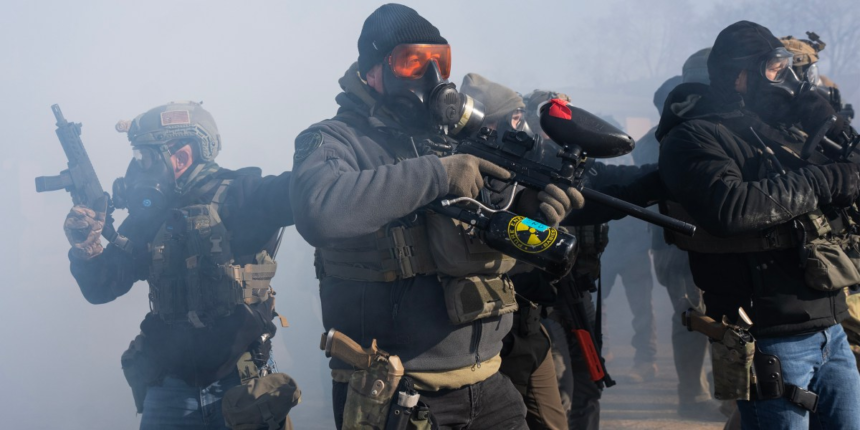
As the operations of Immigration and Customs Enforcement have intensified over the past year, politicians and journalists alike have begun referring to ICE as a “paramilitary force.”
All this raises a couple of questions: What are paramilitaries? And is ICE one?
The term paramilitary is commonly used in two ways. The first refers to highly militarized police forces, which are an official part of a nation’s security forces. They typically have access to military-grade weaponry and equipment, are highly centralized with a hierarchical command structure, and deploy in large formed units to carry out domestic policing.
Many informal paramilitaries are engaged in regime maintenance, meaning they preserve the power of current rulers through repression of political opponents and the broader public. They may share partisan affiliations or ethnic ties with prominent political leaders or the incumbent political party and work in tandem to carry out political goals.
The recent references to ICE in the U.S. as a “paramilitary force” are using the term in both senses, viewing the agency as both a militarized police force and tool for repression.
In these ways, ICE and CBP do bear some resemblance to the informal paramilitaries used in many countries to carry out political repression along partisan and ethnic lines, even though they are official agents of the state.
The ways in which federal immigration forces in the United States resemble informal paramilitaries in other countries – operating with less effective oversight, less competent recruits and increasingly entrenched partisan identity – make all these issues more intractable. Which is why, I believe, many commentators have surfaced the term paramilitary and are using it as a warning.