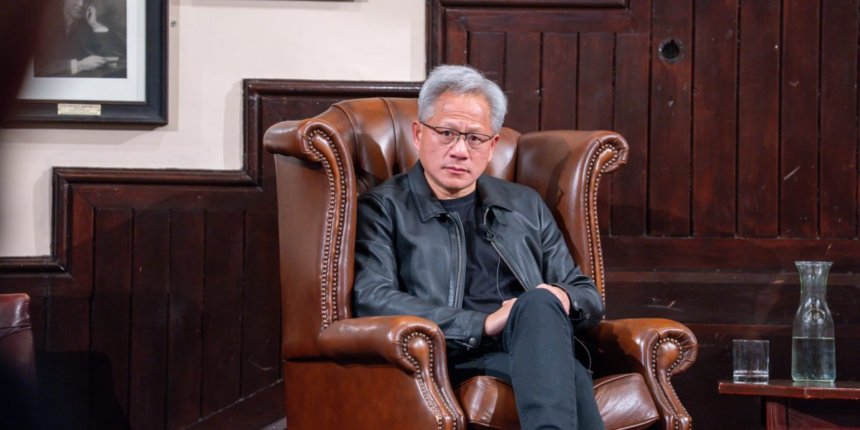
He launched Nvidia from a Denny’s dining booth without a business plan, he said, and had to learn his leadership and management skills on the job. After all, Nvidia is the first and only business he has ever led.
His mantra for success has been simple: “Don’t get bored and don’t get fired,” he said at the event earlier this month.
While that sounds straightforward enough, Huang also warned a life of extreme success in a highly competitive industry like tech is not without its drawbacks.
“In retrospect, I could have been smarter myself, and to be CEO is a lifetime of sacrifice,” Huang told his audience. “Most people think that it’s about leading and being in command and being on top. None of that is true. You’re in service of the company. You’re creating conditions for other people to do their life’s work, you’re inspiring through example. Most of the examples are making difficult decisions during very difficult times, it’s mostly about sacrifiice.”
“It’s about strategy, and strategy … is not just about choosing what to do, it’s about choosing what not to do, which is sacrifice, and the determination, the conviction, the pain and suffering that goes along with overcoming obstacles, that’s all sacrifice.”
The Taiwanese-American entrepreneur attributed his commitment and determination to his parents: His father, determined to see his children grow up in America; and his mother, teaching her children English despite the fact she didn’t speak the language herself.
“My parents wanted us to pursue the American Dream,” Huang said. “They didn’t have very much, they were quite modest, and moving to the United States was quite difficult for us in 1973, but somehow we made our way through it. I think the life of struggle, endeavour, nothing for granted, having to earn anything, I think was good CEO training.”
Huang went on to study at Oregon State and Stanford University, crediting his parents with instilling a belief in him that he could achieve. Wearing his usual leather jacket, Huang added his mother had insisted he was “special,” explaining: “Often times, if people tell you that you’re better, greater, more capable than you are, you might live up to that expectation. It reminds us to do the same with our companies, it reminds us to do the same with each other.”
“[My mother] left me with an impression that nothing could be that hard, to this day, and people have seen me adapt.”