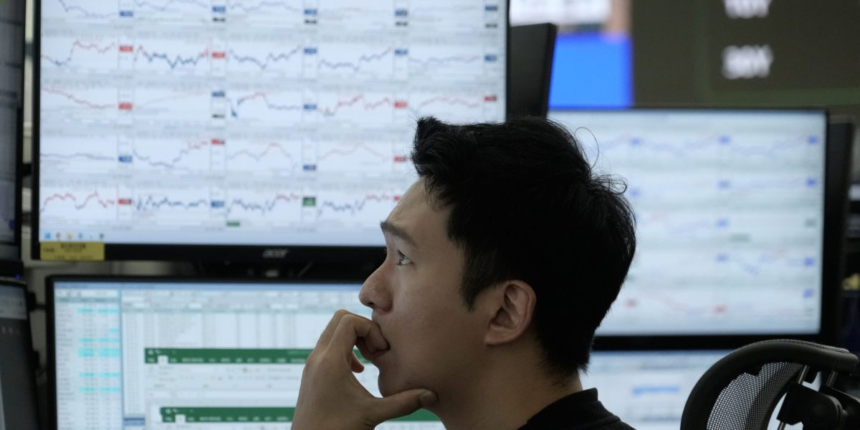
Germany’s DAX fell 1.3% to 23,288.28, while the CAC 40 in Paris lost 1.4% to 8,010.60. Britain’s FTSE 100 declined 1% to 9,581.96.
Asian markets felt a chill after the yield on 30-year Japanese government bonds surged to 3.31%, reflecting rising risks as Prime Minister Sanae Takaichi prepares to boost government spending and push back the timetable for bringing down Japan’s huge national debt.
The yen was trading above 155 to the U.S. dollar, near its highest level since February. On Monday, the Japanese currency fell to its lowest level against the euro since 1999, when the unified European currency was launched.
Early Tuesday, the dollar fell to 155.20 Japanese yen from 155.26 yen. The euro rose to $1.1592 from $1.1593.
Tokyo’s Nikkei 225 dropped 3.2% to 48,702.98, with selling of tech shares leading the decline. Chip maker Tokyo Electron shed 5.5%, while equipment maker Advantest dropped 3.7%.
In Taiwan, the Taiex fell 2.5% as TSMC, the world’s largest contract chip manufacturer, declined 2.8%.
Chinese markets were not immune from heavy selling.
Hong Kong’s Hang Seng declined 1.7% to 25,930.03, while the Shanghai Composite index slipped 0.8% to 3,939.81.
In Australia, the S&P/ASX 200 gave up 1.9% to 8,469.10.
A strong jobs report on Thursday would likely stay the Fed’s hand on rate cuts, while figures that are very weak would raise worries about the economy.
In other dealings early Tuesday, U.S. benchmark crude oil lost 19 cents to $59.72 per barrel. Brent crude, the international standard, gave up 21 cents to $63.99 per barrel.