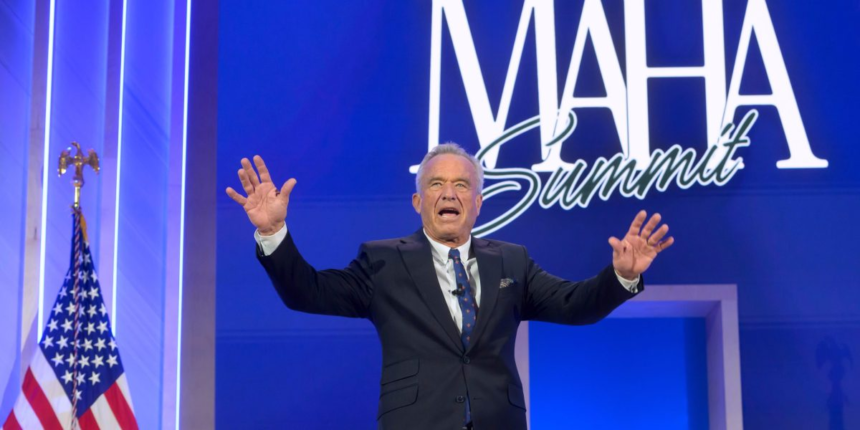
“MAHA is not MAHA anymore,” Gray Delany, a former Department of Health and Human Services official ousted in August, said in a podcast interview that day. “I’m not there, but what I’ve heard of what’s happening today is not the MAHA that we signed up for.”
“MAHA’s growth is a sign of its success,” said HHS spokesperson Andrew Nixon. “Secretary Kennedy is leading a broad coalition to make Americans healthier, guided by transparency, accountability and measurable results. The movement’s meaning hasn’t changed and it’s stronger than ever.”
Public health researchers say the genius that fuels Kennedy’s movement — the universal appeal of making Americans healthier — can also cause conflicts by inviting competing interests.
“This is a tale as old as time in politics,” said Matt Motta, a professor at Boston University School of Public Health. “The bigger your tent is, the harder it can be to make everyone happy.”
In their attacks on the administration last week, a few MAHA influencers and two fired HHS employees suggested White House chief of staff Susie Wiles and Kennedy’s close adviser, Stefanie Spear, were conspiring to limit Kennedy’s ability to restrict vaccines and crack down on pharmaceutical companies.
“Let’s focus on our extraordinary achievements to date and the monumental work that still needs to be done,” Kennedy wrote. “Let’s build our coalition instead of splintering it.”
Since the “Make America Healthy Again” slogan debuted on the campaign trail last year, Kennedy and Trump have widened the MAHA tent considerably by inviting anyone into the fold who has concerns about Americans’ health, nutrition and chronic disease.
That’s attracted a diverse crowd, including moneyed interests — among them health data startups, artificial intelligence firms, drug manufacturers and even fast-food companies. Steak ’n Shake recently promoted its fries cooked in beef tallow, saying it was “proud to be part of the MAHA movement.”
At the recent MAHA event in Washington, hosted by the pro-Kennedy group MAHA Action, Kennedy and other federal health officials appeared on a stage that was occupied throughout the day by biotech companies like CRISPR Therapeutics and Regeneron, the brain-computer interface company Neuralink and various AI companies and health startups. The invitation list raised flags for some longtime Kennedy supporters.
“I was not thrilled about some of the people who were there,” said Leslie Manookian, president and founder of the Health Freedom Defense Fund, a nonprofit that promotes bodily autonomy. “I don’t think that we make America healthy again through pills, creams, injections, pharmaceuticals, chips, monitors, devices.”
Tony Lyons, president of MAHA Action, told The Associated Press that the MAHA movement’s strength “comes from its openness to ideas, from its dedication to including all voices, all perspectives, more dialogue, more fierce debate.”
“We don’t want to exclude anyone,” he said. “We don’t want to censor anyone.”
Ethan Augreen, who led Colorado’s volunteer effort for Kennedy’s presidential campaign last year, said he was concerned both by speakers at the event and by a recent Kennedy social media post about meeting with tech leaders to talk about personal health data.
He said he hoped Kennedy would fight corruption in America’s health care system and remove mRNA COVID-19 vaccines from the market.
“There’s definitely some alarm bells going,” Augreen said. “Grassroots MAHA people definitely don’t trust these corporations, and it’s not really apparent whether the administration is just getting in bed with them or really holding their feet to the fire.”
Kennedy had previously expressed skepticism about GLP-1 weight-loss medications and has said he wants to focus on the root causes of disease instead of medicating the public. But he praised the deal, even as he was careful to add it wasn’t a “silver bullet.”
Dr. Mehmet Oz, the administrator of the Centers for Medicare and Medicaid Services, said during the MAHA event that scrutiny of it from Kennedy’s base was “understandable.” He defended the administration as using Trump’s negotiation playbook instead of going “head-to-head with adversaries.”
Several of Kennedy’s core supporters said they see the government as a deeply entrenched bureaucracy that won’t be easy to reform, even as they hope he’ll be able to remove toxins from food and the environment and further restrict vaccines. Kennedy, at an appearance with western governors Thursday, said he doesn’t intend to take away people’s access to vaccines.
Jeffrey Tucker, founder of the nonprofit Brownstone Institute who has rallied support behind Kennedy, said MAHA activists are idealistic but at times naive about the difficulty of government reform.
“It’s very important to hold on to your ideals,” he said. “But if you’re doing nothing but throwing rocks, then you can become a problem.”
Motta, the professor, said regardless of where MAHA goes next, it’s already bigger than any singular policy position.
“Identities do not go away easily,” he said. “They are deeply held; they are deeply integrated into our sense of self. And I would be shocked if this was a movement that faded.”
___
Associated Press writer Linley Sanders contributed to this report from Washington.