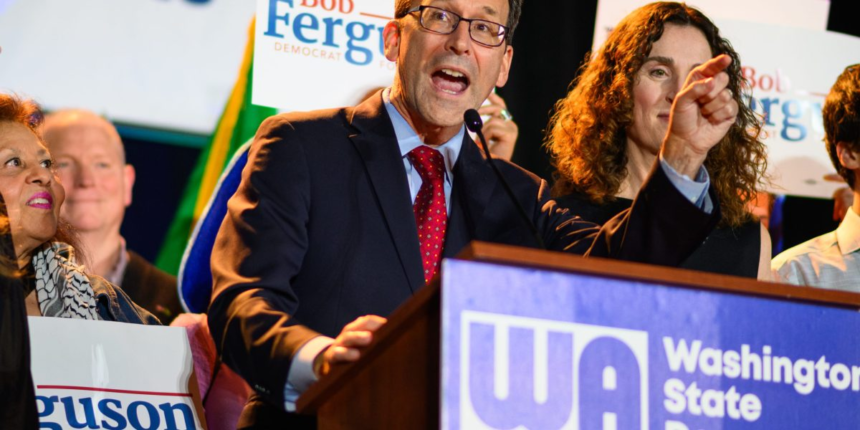
Ferguson on Tuesday asked the legislature to craft a 9.9% tax on personal income over $1 million, which would revolutionize a state revenue system heavily reliant on sales and property tax. Although his fellow Democrats have for decades failed to push through an income tax, Ferguson said it’s “a different time right now.”
“We are facing an affordability crisis,” Ferguson said. “It is time to change our state’s outdated, upside-down tax system. To serve the needs of Washingtonians today, to make our taxes the more fair, millionaires should contribute toward our shared prosperity.”
Democrats across the US are increasingly exploring taxes as a way to capture the populist moment and address the country’s widening wealth gap. If “affordability” was the issue highlighted by Democrats who outperformed expectations in the off-year elections of 2025, the slogan next year could very well be “tax the rich.”
It’s an opening Democrats see as the Trump administration this year paired tax cuts for high earners with reductions in Medicaid and supplemental food assistance. Raising taxes on the wealthy could also help solve a fiscal problem for states dedicating more resources to plug the holes from federal cuts.
New York Mayor-elect Zohran Mamdani campaigned on raising the city’s income tax on millionaires by 2 percentage points to 5.9%, which critics said would lead to an exodus of wealthy people.
Colorado voters this year approved a measure to limit deductions for taxpayers earning at least $300,000. The revenue will fund a program providing free meals for all public school students. Colorado officials also advanced a ballot measure to change the state’s 4.41% flat rate to a graduated income tax, potentially raising more than $4 billion. That will likely go before voters in 2026.
Michigan residents could also face a ballot initiative next year to change the state’s flat 4.25% tax rate to add a 5% surcharge on individuals earning more than $500,000 and couples making more than $1 million.
Even 2012 Republican Presidential candidate Mitt Romney has joined the call. Last week, the former US senator from Utah penned an essay in the New York Times calling for rich people to pay more, mostly in the form of closing loopholes the wealthy use to minimize tax obligations.
“It would help us avoid the cliff ahead,” Romney said, pointing to government funding shortfalls, “and might tend to quiet some of the anger that will surely grow as unemployed college graduates see tax-advantaged multibillionaires sailing 300-foot yachts.”
Most of the populist proposals coming from the states would raise taxes on income. But the tricky thing about some wealth is that it doesn’t come from a paycheck and thus is harder to tax. Even a levy on capital gains depends on a taxpayer selling assets to realize that increased value.
That’s why some Washington state Democrats are still pushing for the US’s first wealth tax on unrealized gains. Under a proposal passed by the state Senate last year, portfolios of some publicly traded asset classes worth at least $50 million would be taxed at 0.5%.
Ferguson panned the wealth tax proposal last year, saying it would be irresponsible to balance the budget on a measure that would certainly face legal challenges.
State taxes are also easier to avoid than federal taxes, because it’s relatively easy to move a primary residency. Washington used to attract taxpayers fed up with California’s high rates, but that has changed since the Evergreen State started taxing capital gains. Next year could be the year of the millionaire’s tax — in Washington state and across the US.