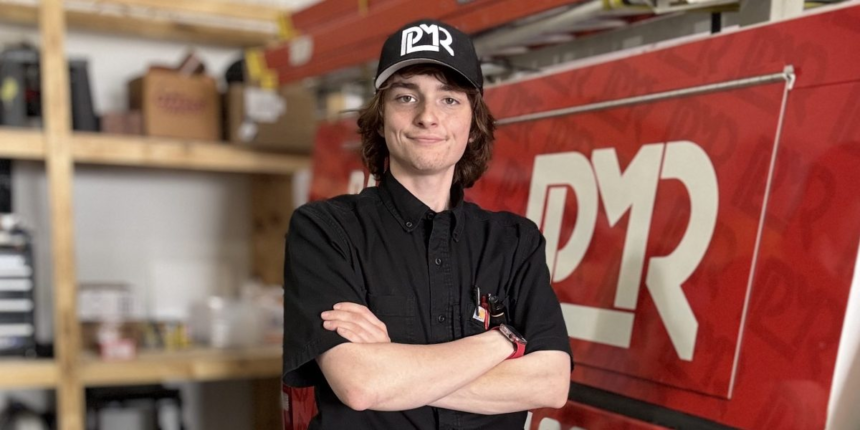
When he returned home, in need of a job, his mom was putting in a hot tub and she mentioned the electrician working on it was “super passionate and loved his job.” Palmer said he sounded him out, estimating that he was about 29 at the time, and liked that he worked for himself. “I had a general interest in working with my hands, fixing and making things, as well as a basic understanding of electrical theory from my time in AP Physics class.” Soon afterward, he started as a full-time apprentice at a small, Charlotte-based contracting firm, earning $15 an hour at first and working his way up the ladder.
“I’m a one-man, one-truck operation,” he explains, adding that he started just doing work for friends, family, and “around the neighborhood.” Soon, word-of-mouth referrals began to flow. As of early September 2025, he’s booked out a month in advance. But the real kicker? He’s 23, debt-free, and fully independent. “I don’t owe anybody anything,” he says, contrasting his position with college-bound peers saddled by loans and job uncertainties.
Loria told Fortune that her district and others nationwide are adopting academy models that blend college, trades, and direct career pathways, giving students options beyond the four-year university pipeline. “Our youth want to know why. Why do I need to go to college? Why do I want to get in debt? Why do I want to do these things?” She said the answer that she used to hear—because I told you so—isn’t cutting it anymore, and as an educator and administrator, she has to come to understand “the reality” of social media’s dominance: “they have access to all of the information at their fingertips.” She says her approach to use a career as the “carrot” to shepherd students into their post-secondary options.
While some of his high school peers enrolled in college, he saw more value in entering the workforce directly. “Having to be in a career that I would personally need to spend time away for four years, and then not even having a surety that my degree is going to … get me job security.” That was something that he just didn’t want to do, he says. Aguilar said he hasn’t even cashed a paycheck yet at his new job, so he can’t give revenue figures, and he was making something like minimum wage before, but he’s still living with his mother and two sisters (he’s the youngest of eight siblings). He’s comfortable living at home “because it really gives me an edge on financials and saving, and obviously I help out with the rent and [other bills].”
Aguilar adds that he “always wanted to be a YouTuber,” recalling videos from elementary and middle school, “literally in the car recording, just eating a muffin, chatting, talking about what happened at school, like someone fell down a stairway. ” He said he was “seeing all the YouTubers, so I kind of wanted that.” After all, he was born in 2005, the same year YouTube was created. When asked if it’s exhausting working two jobs—HVAC and his side hustle—he says that old-fashioned sales is “very draining.” Trying to make a sale with a real person is much harder than putting himself on camera, he says, “because on the camera, you can turn it off.”
Palmer can foresee a time where, like Aguilar, YouTube and content creation takes up a bigger portion of his income and his time, and that will help with the inconvenient fact of just how hard he’s working. He only took one week of “true vacation” over the last year. He is maximizing his weekends, for instance going to a beach on the weekend or work trips attending conferences in different parts of the state. Palmer notes that he’s a member of the North Carolina Electrical Inspectors Association. That’s the downside of being your own boss, he adds: “If I stop, the checks go to zero.”