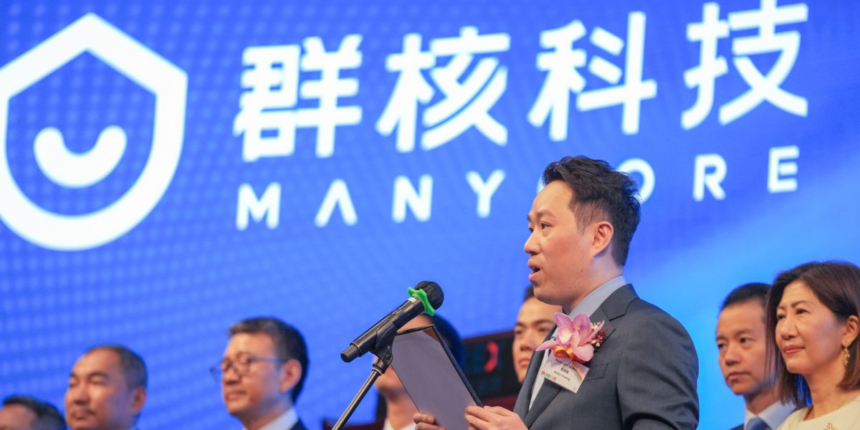
“The IPO is important for us to attract the most talented engineers to join us, to buy more GPUs, and to collect more data,” Victor Huang, Manycore’s chair and one of its cofounders, told Fortune ahead of the trading debut.
Manycore shares closed at 18.60 Hong Kong dollars ($2.38), 144% above the offer price of 7.62 Hong Kong dollars.
The Hangzhou-based startup is a bet on “spatial intelligence,” moving beyond the word- and language-based work of large language models like OpenAI’s GPT and DeepSeek’s V3 to instead create AI models that can autonomously work in the real world.
Huang described spatial intelligence as similar to a person’s or animal’s innate ability to understand the world around them. “When you enter a room, you can understand where you are and what’s in front of you. And if you want to take a seat, you can understand which seat is empty,” he explained.
“People are now trying to apply AI in the physical dimension,” said Jixun Foo, senior managing partner at Singapore-based venture capital firm Granite Asia, and an early backer of Manycore. He pointed out that viral videos of humanoid robots dancing, while impressive, are often carrying out preprogrammed routines. “If you want a different performance you have to program it again. You can’t just tell the robot to do this or that action.”
Instead, “we’d accumulated a huge amount of 3D data, almost 500 million assets from the real world. We had the training data, so we believed we could make the best physical AI in the world,” he argued.
China’s AI sector has released many of its models on an open-source basis, which has helped boost the reputation of its AI startups and won converts in the global tech sector, including in Silicon Valley. “People try Chinese AI. It’s free. It’s open-source. And when they try it, it’s great,” Huang explained. Manycore has already released several open-source models, including SpatialLM, a spatial language model that can understand and generate 3D environments, and SpatialGen.
But Foo thinks a company like Manycore can preserve its edge even if it open-sources its models. “For Manycore, it’s not just about their model, but also the dataset they have built. That dataset is unique to them, right? If you have a competitive edge that you can hold on to, then you can open-source something,” Foo said.
The company got its start as a design software business, building Kujiale, a platform that lets users create 3D renderings of interior spaces, and its international counterpart Coohom, which now serves customers in more than 200 countries. IDG Capital and Hillhouse Investment are among its previous backers.
Huang was an engineer on Nvidia’s CUDA team before returning to China to build a business around rendering. “The economy in the U.S. wasn’t doing well at the time, but in China, real estate was booming,” he recalled.
“Nowadays, the Hong Kong market is the best for a Chinese AI company,” Huang says.
Bonnie Chan, CEO of Hong Kong Exchanges and Clearing, pushed back at this week’s HSBC Global Investment Summit against the characterization of the market as simply a conduit for Chinese capital. “When people say that Hong Kong’s stock exchange is just hosting Chinese companies, it’s not doing those companies justice,” she said, noting that around 40% of companies that listed in Hong Kong last year generated more than half their revenue from non-Chinese sources. “I call them Chinese MNCs [multinational corporations]. They’re very international.”
China’s AI sector has been under fresh scrutiny from global investors since early last year, when DeepSeek—another of Hangzhou’s Little Dragons—released its powerful and surprisingly efficient models, changing the conversation about Chinese innovation.
“Our strategy is to be able to invest in companies early. We want to help them grow and scale outside of their home market,” Foo says. “We have a good pipeline of companies going IPO.”
Update, April 17, 2026: This article has been updated with Manycore’s first-day share performance.