Some Venezuelan civilians and members of the military were killed, said Rodríguez, who didn’t give a number. Trump said some U.S. forces were injured, but none was killed.
Speaking to reporters hours after Maduro’s capture, Trump revealed his plans to exploit the leadership void to “fix” the country’s oil infrastructure and sell “large amounts” of oil to other countries.
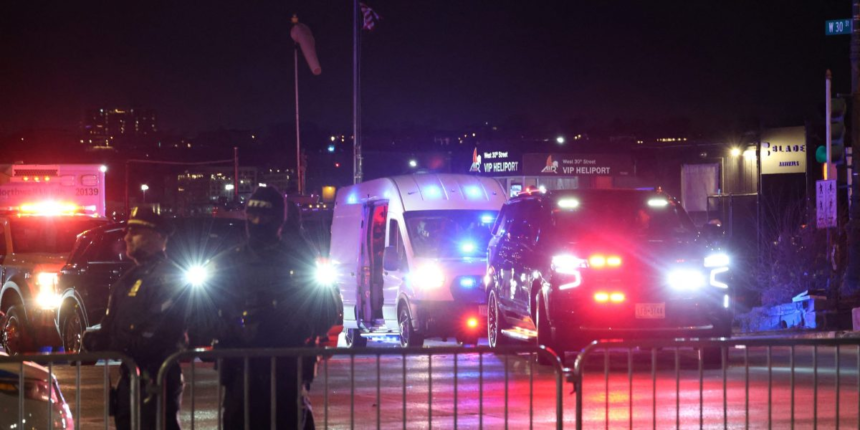
After arriving at a small airport in New York City’s northern suburbs, Maduro was flown by helicopter to Manhattan, where a convoy of law enforcement vehicles, including an armored car, was waiting to whisk him to a nearby U.S. Drug Enforcement Administration office.
A video posted on social media by a White House account showed Maduro, smiling, as he was escorted through that office by two DEA agents grasping his arms.
The Trump administration promoted the ouster as a step toward reducing the flow of dangerous drugs into the U.S. The president touted what he saw as other potential benefits, including a leadership stake in the country and greater control of oil.
Trump claimed the U.S. government would help lead the country and was already doing so, though there were no immediate visible signs of that. Venezuelan state TV aired pro-Maduro propaganda and broadcast live images of supporters taking to the streets in Caracas in protest.
“We’re going to run the country until such time as we can do a safe, proper and judicious transition,” Trump said at a Mar-a-Lago news conference. He boasted that this “extremely successful operation should serve as warning to anyone who would threaten American sovereignty or endanger American lives.”
Maduro and other Venezuelan officials were indicted in 2020 on narco-terrorism conspiracy charges, and the Justice Department released a new indictment Saturday of Maduro and his wife that painted his administration as a “corrupt, illegitimate government” fueled by a drug-trafficking operation that flooded the U.S with cocaine. The U.S. government does not recognize Maduro as the country’s leader.
Taking place 36 years to the day after the 1990 surrender and seizure of Panama leader Manuel Antonio Noriega following a U.S. invasion, the Venezuela operation unfolded under the cover of darkness early Saturday. Trump said the U.S. turned off “almost all of the lights” in Caracas while forces moved in to extract Maduro and his wife.
Gen. Dan Caine, chairman of the Joint Chiefs of Staff, said U.S. forces had rehearsed their maneuvers for months, learning everything about Maduro — where he was and what he ate, as well as details of his pets and his clothes.
“We think, we develop, we train, we rehearse, we debrief, we rehearse again and again,” Caine said. “Not to get it right, but to ensure we cannot get it wrong.”
Under Venezuelan law, Rodríguez would take over from Maduro. Rodríguez, however, stressed during a Saturday appearance on state television that she did not plan to assume power, before Venezuela’s high court ordered that she become interim president.
“There is only one president in Venezuela,” Rodriguez said, “and his name is Nicolás Maduro Moros.”
Venezuela’s ruling party has held power since 1999, when Maduro’s predecessor, Hugo Chávez, took office, promising to uplift poor people and later to implement a self-described socialist revolution.
Venezuela’s capital remained unusually quiet Sunday with few vehicles moving around and convenience stores, gas stations and other businesses closed. A road typically filled with runners, cyclists and other fitness enthusiasts on Sundays only had a handful of people working out the day after Maduro was deposed.
The presidential palace was guarded by armed civilians and members of the military. At a nearby plaza, only a street sweeper and a soldier stood, and across the street, a church remained close for a second day in a row.
Caracas resident David Leal arrived to the lot where he parks vehicles for a living only to quickly realize that he would likely not see any clients for a second day.
“People are still shaken,” Leal, 77, said.
Whether the United States violated any laws, international or otherwise, was still a question early Sunday. “There are a number of international legal concepts which the United States might have broken by capturing Maduro,” said Ilan Katz, an international law analyst.
Pope Leo XIV, who last month had expressed concern about growing U.S. threats of military intervention in Venezuela, raised alarms during his Sunday noon blessing and said the good of the Venezuelan people must prevail above everything else. History’s first U.S. pope demanded an end to violence and for Venezuela’s sovereignty to be guaranteed.
In New York, the U.N. Security Council, acting on an emergency request from Colombia, planned to hold a meeting on U.S. operations in Venezuela on Monday morning.
Lawmakers from both American political parties have raised reservations and flat-out objections to the U.S. attacks on boats suspected of drug smuggling. Congress has not approved an authorization for the use of military force for such operations in the region.
Connecticut Rep. Jim Himes, the top Democrat on the House Intelligence Committee, said he had seen no evidence that would justify Trump striking Venezuela without approval from Congress and demanded an immediate briefing by the administration on “its plan to ensure stability in the region and its legal justification for this decision.”