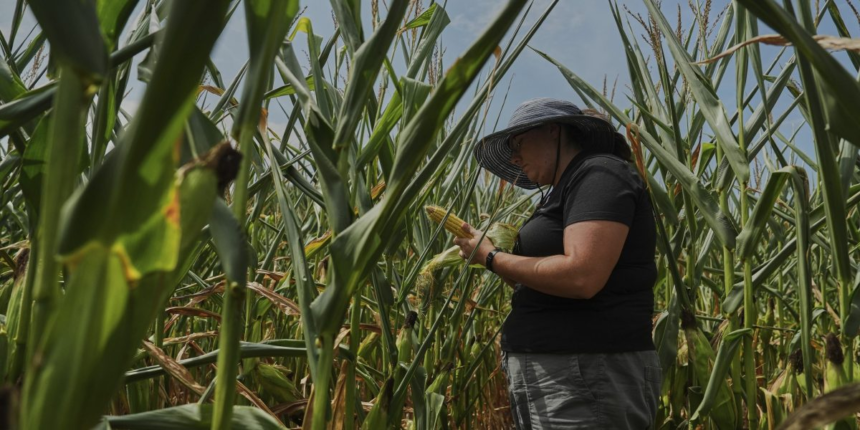
Robb Rynd and his brother grew up farming and wanted to do more of it outside their day jobs, so they went in together on what’s now a little over 200 acres of corn, soybeans, wheat and sorghum. Last year was a good year, and Rynd said he enjoyed walking the fields with his kids to see how the corn was doing.
This year is a different story.
All summer he’s been scouting for brown and wilting leaves or ears of corn with kernels missing, and now it’s becoming clear that every kernel will count this harvest. “It’s almost kind of depressing to go out there and look at it and say, ‘oh yep, it does look bad,’” he said.
Overall, corn growers got lucky this year with late-season weather that contributed to what is now predicted to be a record bumper crop. But experts say bouts of extreme weather are intensifying the waiting game during a critical time of year between planting and harvest.
”The hot nights too, like the corn’s never getting a break. It’s just hot all the time,” Rynd said. “I know it’s wearing on me.”
As a corn plant grows, the leaves unroll to reveal the tassel, the part that sheds pollen, explained Mark Licht, an associate professor of agronomy and an extension cropping systems specialist at Iowa State University. If the plant grows too fast, which can happen when it’s consistently very hot, the tassel may be wrapped too tightly by the leaf, meaning less pollen gets released.
He said farmers are having to pay more attention to this because “there’s just more variable weather.”
That, combined with consistent heat, means that “we are expecting a monster U.S. corn crop in 2025,” Rippey said.
But it wasn’t easy for everyone. “This has probably been one of the most difficult growing seasons that I’ve experienced in my career,” said Philip Good, a farmer in Macon, Mississippi and chair of the United Soybean Board. He planted his corn and soybeans 60 days behind schedule because it rained nearly every day for two months.
They lost some fertilizer and some plants died in standing water, Good said, but they made up for it with some lucky weather later in the season.
Late summer is a make-or-break time for farmers: They’re trying to gauge how much they’ll make from the year’s crop and planning their next steps, and patchy pollination doesn’t help.
“We’d like to upgrade a tractor … or we’d maybe try to pick up some more ground,” Rynd said. “It’s hard to want to go do those things when you have a bad year like this.”
When the uncertain pollination is at its worst, if 15% to 25% of every ear of corn doesn’t have kernels, that could mean a significant yield loss over a large field, said Nicolle Ritchie, a Michigan State University extension agent who helps Walton and Rynd survey their crops.
Jason Cope co-founded a farm tech company called PowerPollen whose equipment can mechanically collect pollen and then pollinate future crops. He said that due to extreme weather events, the number of “rescue” pollination jobs they’ve done for customers — to save fields that didn’t naturally pollinate very well — has nearly doubled since they started in 2018.
Walton said he can manage as long as the pollination issues don’t get too bad.
“You learn to roll with the stress part of it because most of that you can’t control anyway,” he added.