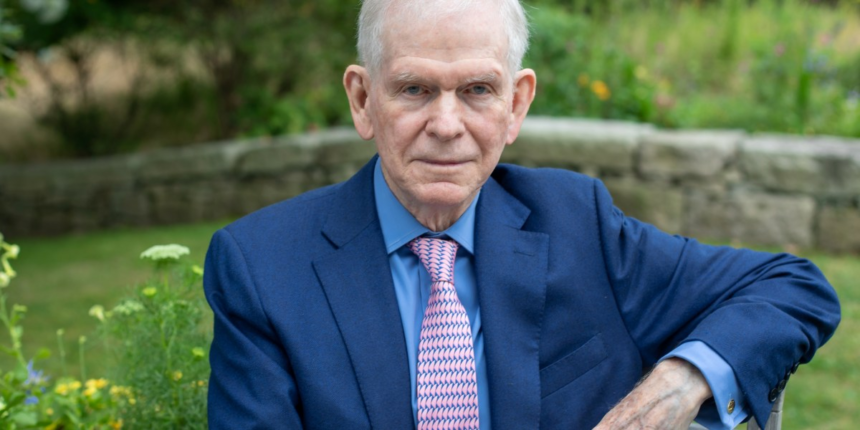
Jeremy Grantham has been called many things. Permabear. Doom merchant. Cassandra with a British accent. For decades, the co-founder of the Boston-based asset manager GMO has warned that financial markets were inflated to dangerous, unsustainable heights—and he has made enemies for it. But ask him how he feels about all of it, and he sounds almost cheerful.
“Data is data,” he told Fortune in a recent interview. “I quite like thinking these things through.”
The equanimity makes more sense once you know his Myers-Briggs “animal”: he’s a dolphin.
So that settles it, according to the co-author of the recently released memoir, The Making of a Permabear, written alongside financial historian Edward Chancellor. He’s not a bear — he’s a dolphin, driven by a powerful streak of idealism, the kind that lets you pursue an uncomfortable truth, call it better than anyone else, and feel quietly satisfied even when no one wants to listen. He calls the whole framework “Myers-Briggs crap,” but admits the data shows it works—which, he notes, is more than you can say for most of the academic models that are supposed to.
People don’t react well to the bear—or the dolphin—in the room, Grantham said. “It makes people really angry,” he explained, “but not uniformly.” The angriest reactions are “when things are getting really crazy” in markets, he said, recalling a quarterly letter he wrote in 2021, around the theme of “waiting for the last dance.” In January 2022, he talked about in a Bloomberg podcast appearance and found the response “ballistic and viral, I think is the expression.” It struck a nerve with the Bitcoin crowd, he explained, who are “crazy as coots,” and three particular comments “went to great lengths to point out that I had big ears, for God’s sake. I had not heard that since I was about six or seven years old.”
Grantham’s current thesis is that U.S. equities are trapped inside what he calls a “bubble within a bubble.”
The original super-bubble, as he sees it, was already inflating dangerously through 2021 before the S&P 500 started to crack. People don’t remember it now, but the S&P 500 had actually fallen about 25% from January through October 2022, but then ChatGPT arrived. “The day after Chat came out, the Mag 7 lifted the market on its broad shoulders and staggered forward,” he said, injecting a fresh speculative frenzy on top of an already overvalued system. The AI boom didn’t fix the underlying problem, according to Grantham— t deferred it while making it larger.
His diagnosis is that the market is constitutionally incapable of looking further than the present moment. It extrapolates current conditions, piles fat price-to-earnings multiples on top of already-fat profit margins, and double-counts prosperity. “The stockbrokers would die of boredom” if bubbles didn’t get inflated, Grantham said. “The investors would die of boredom and a lot of money would be saved; the turnover would drop and everyone would end up making exactly the same money with a lot less excitement and doing a lot less crazy things.”
It’s almost as if owls, foxes, and dolphins are all jostling together, contending with their animal spirits more than with any rational analysis of data.
Fortune responded that Grantham’s worldview sounds like the 17th-century quote from the French philosopher Blaise Pascal: “all of humanity’s problems stem from man’s inability to sit quietly in a room alone.”
That is “absolutely true,” Grantham responded, before getting back to his nuts-and-bolt analysis of all the data he currently sees as quite disturbing. But this also takes him somewhere that most market commentators won’t follow.
“There are kind of layers of time around reality,” he said. “Forget the stock market, which really has a very short horizon and extrapolates today’s conditions — the environment the current market is operating in is clearly about as bad as it ever gets.”
This is Grantham’s deeper, more dolphin-ish insight: a lot more than the fate of the S&P 500 is at stake. Nothing less than the long-term viability of the way we live is on his mind. Grantham put the turning point back in 2011, when he wrote a paper called Time to Wake Up, arguing that the earth was running out of abundant resources. “We were the first people that actually said, ‘Dudes, for 100 years, we’ve had technology at a bigger level than scarcity.’” The takeaway: “We are going to have to get used to slower growth rates, lower resource use.” And most societies, he said, have no plan for dealing with it.
Although the U.S. fertility rate is below replacement, it is nowhere near South Korea’s figure, but Grantham stressed the long view, globally: “We’ve palled up with the experts who’ve studied these things for literally 30, 40 years, they think that in as little as 20, 25 years, the average young couple will need help … [and] in 40 to 50 years, the viability of the species is at risk.”
So why isn’t any of this depressing him?
He also told Fortune he was philosophical about human nature and the animal spirits that drive economies—and societies—forward. “I suspect over hundreds of thousands of years that pessimism was not a great help to survival,” he said. “Everyone left hanging on by their fingernails, good times, bad times, everyone’s dying, running out of food, lots of food, running out of food again. But being an optimist is probably a great help.” We are probably an optimistic species as a result, he argued, “but optimism, in a sense, by definition, means you’re not in a great position to do unbiased analysis.”
Grantham has decades of experience, he has just published his memoir, and he is telling you, with the cheerful conviction of a man who has been right before and expects to be right again, that the world is running out of time, resources, and people.
He is also telling you that almost no one wants to hear it. But that’s the thing about being the only dolphin in a room full of owls: you get used to swimming alone.