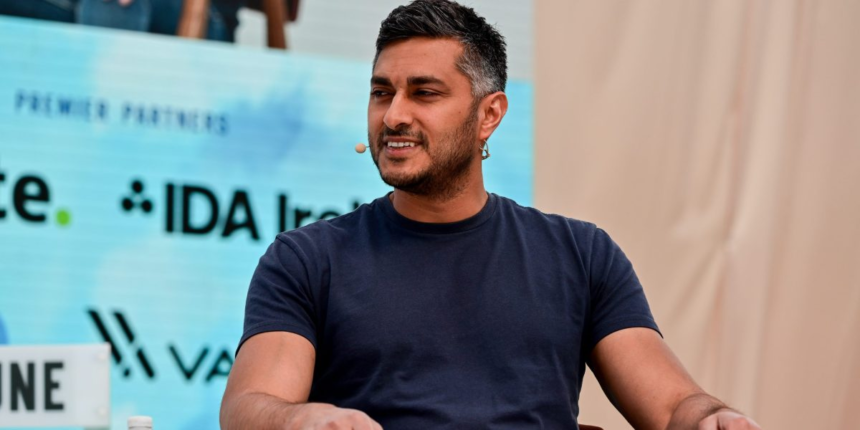
“My neighbors think I’m under house arrest,” observes Arjun Sethi. It’s not hard to see why. On the driveway of Sethi’s comfortable Menlo Park home, located a few miles from Stanford University, sits a black Cybertruck that rarely leaves. Meanwhile, various figures stream in and out of a wide open garage anchored by a table littered with electronics. Inside, there are no pictures on the walls and the domicile’s only personality is supplied by a large German Shepherd patrolling the backyard.
Sethi is no criminal, though, and the house is not just his home. It is also the prime outpost for Kraken, the longtime cryptocurrency exchange where Sethi, who draws few lines between his personal and professional life, is co-CEO. The gray-flecked 42-year-old, who favors plain t-shirts, may not be concerned what his neighbors think of him. But he does have to care about the opinions of another group: Kraken’s investors, who are expecting big things in the near future.
Meeting that challenge will fall to Sethi who, despite an official title of co-CEO, is very much calling the shots at Kraken. An executive whose experience lies primarily in venture capital, he is an unusual choice to lead a company on the cusp of going public, but one very much in keeping with Kraken’s history as an unconventional company.
Sitting at a large desk plunked in the center of his sparse living room one August afternoon, Sethi patiently replies to my questions as random figures pop in and out of the garage. He has a wide range of intellectual interests—he dabbled in journalism in college and has read extensively on major religions—but for Sethi nearly everything comes down to data.
If the unsentimental Sethi has a passion, it is the idea of using blockchain technology to fix obstacles in the financial system that prevent people from tapping into collateral they own. He cites, for instance, the common conundrum faced by employees who leave a startup and must exercise their stock options and pay related tax within 90 days—resulting in many of them simply walking away from their equity. The solution, Sethi says, is tapping into the modular stack of services offered by decentralized finance (DeFi), which promises to give consumers an unprecedented degree of control over their assets, and let them lend or securitize them like never before.
“My hope with crypto is to distribute those benefits more evenly. We’re not all the way there, but the first steps are happening—stablecoins, then tokenized assets, and now tokenized equities,” said Sethi.
His vision is for Kraken to be a hub for all of these things, bringing the best elements of crypto and the traditional financial stack under one umbrella. To this end, the company spent $1.5 billion this spring to buy NinjaTrader, a platform for professional asset traders, in a move that boosted Kraken’s customer base by 2 million and represented, in Sethi’s words, the “largest-ever deal combining TradFi and crypto.”
The concept of blockchain-based stocks may seem exotic or downright unnecessary, but look closer and the early response to xStocks appears to validate Sethi’s views on where finance is going. He notes that xStocks, which the company hopes to offer in the U.S. next year, are taking off in markets like South Africa where the fees to purchase traditional stocks from brokerages can still be over 10%. By offering shares on a decentralized blockchain platform—xStocks can even be traded outside of Kraken’s exchange—there is less opportunity for middlemen like brokerages to exact high fees.
Unlike most startups, Kraken made it this far with very little in venture capital funding, raising only $27 million from its founding until this year. That recently changed, however, as the company decided to raise a $500 million round as part of its final gear-up for an IPO. The Information reported in July that the company was seeking to raise that amount; this week Fortune learned, from a person who was not authorized to discuss the matter publicly, that it successfully closed the round this month. The round featured no primary investor with Kraken itself setting the terms, including the $15 billion valuation, said the person. Contributors included investment managers and venture capitalists, as well as Sethi’s Tribe Capital and Sethi in a personal capacity.
Following our sit-down interview, Sethi and I take a turn around his Menlo Park neighborhood, and return to his house for dinner with a member of his team and a cousin who has turned up. The meal is delicious but unusual.
The cousin has arrived with coolers full of stone crabs, which he and Sethi scatter on plates of ice around the kitchen. There is a shortage of crab utensils but, since this is Silicon Valley, Sethi punches an order into an app and more appear at the door in a matter of minutes—a trick he performs several times over the course of my visit.
The main course comes in the form of thin, marinated filets of something (Sethi won’t say what) that have arrived in a same-day delivery from Wyoming. Sethi artfully grills the stack of filets in his backyard, serving them with a nice California red and that’s all.
The dinner was par for the course for how Kraken operates more broadly.
In 2022, Powell stepped down as CEO amid a federal investigation into his role at a Sacramento arts non-profit he had founded. The probe created a multi-year legal ordeal for Powell, including an FBI raid of his house that was leaked to the New York Times.
That same person praised Sethi’s command of product, but also complained that the new leader appeared indifferent to staff morale, and has run Kraken more like a venture capital firm than a company, relying on outside associates more than longtime staff. The person added that Sethi’s ongoing ties to Tribe Capital, where he is Chairman, pose a conflict of interest.
“Arjun is Chairman of Tribe Capital, but doesn’t run [Tribe’s] business day to day. This arrangement was approved by both the Kraken and his LPAC [Limited Partner Advisory Committee] at Tribe,” said a Kraken spokesperson.
Sethi’s arrival also roughly coincided with the departure of a number of senior executives, including Kraken’s CTO, its COO, senior sales staff and its longtime lawyer. While executive turnover occurs at every organization, the scope of change at Kraken has likely contributed to the company’s IPO bid getting pushed to 2026 even as a spate of other crypto firms have gone public this year.
Another former executive contacted by Fortune, who asked not to be identified due to legal constraints, also made the case that Sethi’s disruptive management style was necessary to prepare the company for its IPO push. The person added that Kraken’s many years in business had resulted in more pre-IPO regulatory and operational issues than other firms, and added that the co-CEO role has served the company well, with Ripley excelling at internal operational issues and Sethi handling sales and public-facing roles.
Following a period of investor exuberance that peaked in 2021, the window for new companies to go public all but closed as investors came to see startups valuations as overly inflated. That finally changed this year and, for crypto companies, a new appetite for public companies combined with regulatory tailwinds has led to an IPO bonanza.
In the last few months, stablecoin issuer Circle enjoyed one of the biggest same-day IPO pops in corporate history, while lesser lights of the crypto scene like Gemini and Bullish also made successful public debuts. For Kraken’s investors, the company’s decision to wait until 2026 to list publicly is likely a source of frustration and anxiety. Will the market still be eager for another crypto IPO?
All of this increases the pressure on Kraken to hasten its IPO. But if the bottom falls out of the market before it has time to list, Kraken investors can take comfort that—far more than most other crypto firms—it has a sound business model and multiple revenue streams. The company is also seeing growth in numerous key markets outside of its longtime strongholds of Europe and the U.K.
This means Kraken, regardless of how its IPO plans shake out, is built to play the long game.
“Our model’s built around pro traders and institutions,” says Sethi. “Features like Kraken Pro, our robust API, and advanced interfaces make us a destination for funds and high-volume clients—they use our exchange not because it’s flashy, but because it works and the liquidity is deep.”
In the future, Kraken will be in an even better position if Sethi’s vision of a total convergence of traditional finance and crypto comes to pass. If it does, the company’s investors and executives—especially Sethi—stand to make a tidy bundle. So much so that Sethi will have the resources to easily fund a charm offensive to win over his suspicious neighbors—provided, of course, that he cares about such things.