Jack Schlossberg thinks his grandfather would have been great at social media. He’s less sure JFK would recognize the country he once led.
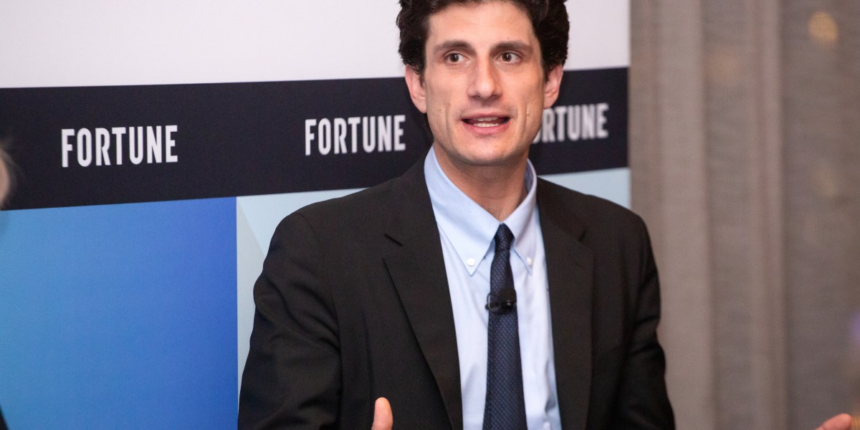
“I think he would be shocked at how far we have fallen in terms of setting the standard for the rest of the world to follow on human rights, democracy, and freedom,” the 33-year-old Democratic congressional candidate told Fortune on the sidelines of a CEO Initiative dinner in New York City on Wednesday night.
“I think my grandfather would be proud of how much our society has accomplished together,” he said.
Schlossberg is the only grandson of President John F. Kennedy, the son of Caroline Kennedy, and is widely seen as the next standard-bearer of the Kennedy political legacy. His comments tap into a broader anxiety about America’s global standing—and highlight the central tension in Schlossberg’s political message: pride in the country’s achievements, paired with concern about its direction.
He argued that Kennedy, the man who solved the Cuban Missile Crisis in the 1960s, “without firing a shot and stared down the Soviet Union without blinking,” would be unsettled by the same problems the country is still facing six decades later, from healthcare to education to immigration. “We need to do better.”
The backbone of his campaign is built around a slogan he acknowledges is “a little cheesy”: believe in something again.
Speaking to Fortune’s Diane Brady, Schlossberg connected his grandfather’s legacy to what he sees as the Democratic Party’s defining failure of this moment: not a collapse in policy, but a collapse in conviction. “I want a party that has the courage again and gives people something to believe in again, because we are right now at an all-time low for people who believe in government.”
“I don’t think that people are as disillusioned as you might expect, and I don’t think that they are as far left as some of the rhetoric would have you believe,” he said. The real problem is a market failure. “There hasn’t been people serving the market of young people who are interested in politics and what they want to hear about. Young people are not a monolith, and young people are really smart. They [are] really able to tell authenticity from someone who’s not telling the truth.”
Voters “aren’t looking for a superhero,” he said. “They just want someone who kind of knows how to speak their language, meet them where they are, and give them something of value.”
“Other than my mother, I’m probably the last person who expected me to be a content creator,” he said. “That was not really my path in life.”
In 2024, Schlossberg headed to Wilmington, Delaware, to offer his ideas to the Biden campaign. They were not well received. “Long story short, I quit the campaign because I thought, if I don’t do this my way, I’m not going to be able to live with myself,” he said. About a month later, the campaign called him back.
The experience only sharpened his diagnosis of the party’s broader problem: “We’ve been out-competed in terms of reaching young people, especially…and telling them a story about what we’re for and not just being a reactive party that is against things.”
His advice for politicians trying to reach voters: “Be all parts of yourself. You don’t just have to be the candidate. People respond when you’re also the uncle, or the son, or the sports fan, or the humorous person that you might be. It’s about showing all different sides of your personality.”
On the sidelines, Schlossberg reiterated his take: “The Democratic Party was definitely late to the game on social media a year and a half ago.”
Schlossberg’s formula for viral social media success? Have no formula at all.
“My social strategy is to have none,” he said. “It’s to try to provide value to people, whatever that may be,” emphasizing that while he leans on jokes and witty takes, he always wraps it around something substantive.
“Maybe it’s a sense of humor, maybe it’s something inspiring, an accomplishment, or maybe it’s laying out information in a clear and intelligible, digestible way so that people can get educated,” he said. “A lot of the videos that do the best aren’t the ones that are wacky or pictures of me, a lot of times, they’re videos where I clearly lay out information in a way that people can understand.”
And if his grandfather were alive today?
“I think he would have no idea how to use a phone, but I think, for some reason, he would probably be pretty good at social media. He was very media savvy in his own day.”