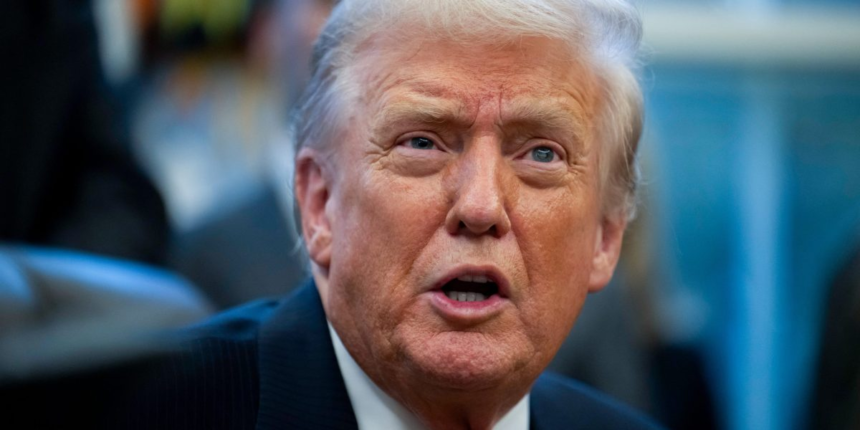
Days before President Donald Trump was sworn in for his second term, he acknowledged the high prices Americans were seeing at the gas pump and grocery store, pledging to bring them down.
“Data show wage growth has slowed more in the trade and transportation sector, and to a lower level, than any other major sector since the end of last year. Fears workers would be able to secure larger wage increases in response to the tariffs look highly unlikely to be realized,” the analysts wrote.
Peter Loge, a professor of media and public affairs at George Washington University, who served as senior advisor to the FDA commissioner under President Barack Obama, told Fortune that Trump’s economic priorities can be ascertained by whom he surrounds himself with.
“What we have today is a small group of individuals who feel intense certainty paired with relentless power control—and on the other, it is a sea of despair,” he told Fortune. “And that’s the piece that never gets talked about.”
“People want to know that they can afford a medical bill if they get sick, their kids will have a better future than they do, or have a chance of a better future,” Loge told Fortune. “And if voters feel like things aren’t working, they fire their politicians in charge to hire new ones.”
“Voters are pretty well saying, ‘We don’t think whatever the Republicans are doing is making stuff less expensive. We need life to be more affordable and less chaotic. It’s pretty unavoidably chaotic. Now we’re going to bring in new people to try a new thing,’” Loge said.
“We learned a lot,” Trump said. “Republicans don’t talk about it. They don’t talk about the word affordability.”
“People want things (generally ‘better’ things than they currently have) and are upset that they cannot afford those things,” Donovan wrote. “This may make affordability a more enduring problem than in the past.” He added that social media “fuels resentment” about affordability, as it presents “carefully curated, idealized lifestyles” that are just out of reach to anyone with a smartphone.
Loge hesitated to make predictions about what this changing sentiment means for upcoming elections, particularly if Trump’s tariffs are indeed successful, which could result in an outpouring of support for future Republican candidates. However, he suggested legacy or incumbent politicians from both major parties will have challenges getting elected. Atwater believes the desire—and need—for affordability transcends party lines.
“We, particularly those on the left and the right and the establishment, woefully underappreciate how purple the bottom is,” he said. “The unified despair, the sheer desperation on both sides of the aisle, and that will continue to lead to an anti-establishment vote,” he said.
“This is a crisis of confidence,” Atwater said. “Sadly, those who are in the best position to address it seem at best indifferent, and that does not go unnoticed by those at the bottom.”
Nick Lichtenberg contributed reporting