The labor market has behaved strangely since the pandemic. President Trump’s anti-immigration drive has reduced the number of available workers. Employers have been reluctant to hire for new roles. Unemployment has ticked up but isn’t out of control by historical standards. Hiring remains tight, in a “low-hire, low-fire” environment.
Secondly, America’s institutions—the courts, the central bank, its federal agencies—have been politically swayed by the Trump Administration. Economists are no longer sure they act independently to provide the checks and balances that historically made the U.S. economy a transparent, and therefore trustworthy, place to do business.
The former Fed Section Chief who once served as Obama’s senior economist doesn’t think a blow-out event will crash the American economy. Rather, her fear is that aggregating events will reshape these two fundamental factors, and that the usual responses from policymakers are unlikely to be fit for purpose.
If a path can be charted, Sahm fears we’re moving the wrong way down it.
“I get concerned when I hear ‘Well, we don’t have layoffs, so we don’t have a recession,’” Sahm told Fortune in an exclusive interview. “But you do have a very low hiring rate. It might not be an aggregate event, it might not be a broad-based contraction like we see in a recession, but it certainly has real implications for workers coming into the labor market.”
“Something’s happening here,” Sahm adds. “It’s clearly bad for people looking for work, but we can’t just have this, ‘Oh, if we avoid a recession, all is good.’ It could be that we’re dealing with much more structural shifts, and those aren’t just hard to forecast; they’re hard to assess in the moment because those structural shifts can be very slow.”
“But against the backdrop, as best we know from the data, business activity looks pretty OK, consumer activity looks OK. I’m concerned that stimulating more demand isn’t what’s holding back hiring—there’s something else.”
Sahm’s own creation isn’t demanding action: Currently, the recession indicator is sitting at a mild 0.35. She warned policymakers against relying too heavily on the tool in the current cycle, saying their attention should be focused—”maybe even more so”—on the labor market because “it doesn’t hold the typical pattern, which means our typical tools to fight [it] like a recession may not be the right ones.”
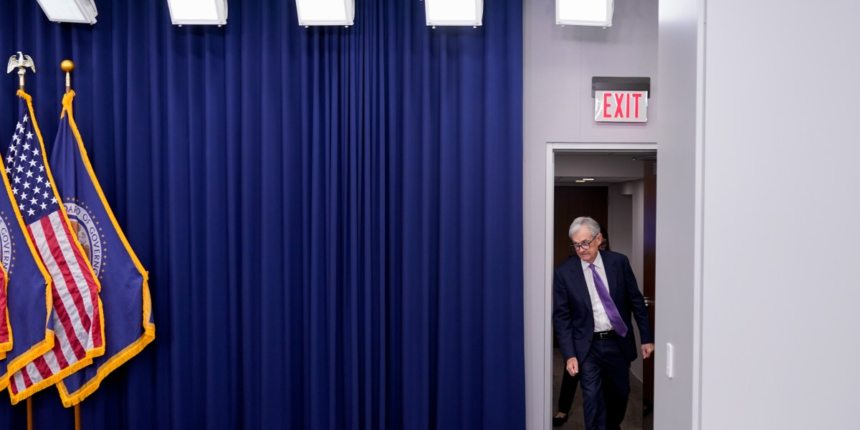
“I think we can look and say up to this point with pretty high confidence, that it’s been economics driving the interest rates,” Sahm said. “What I have a hard time with is [that] the escalation has continued, and the Fed itself is going to go through a transformation this year with a change in leadership. If Powell had two or three more years on his tenure as chair, I would feel more confident than I do with the fact that he has four months left.”
“We’re not on a good path, and while I applaud Jay Powell for standing up and having a statement and pushing back, over the long haul that’s not a sufficient check on pressure,” she added. “I don’t know where this goes, and [where] the economy may. We may see inflation come down more rapidly, we may end up in an envionment where lowering interest rates makes sense and we diffuse the issues by that.
“But I just don’t have a good feeling about this.”