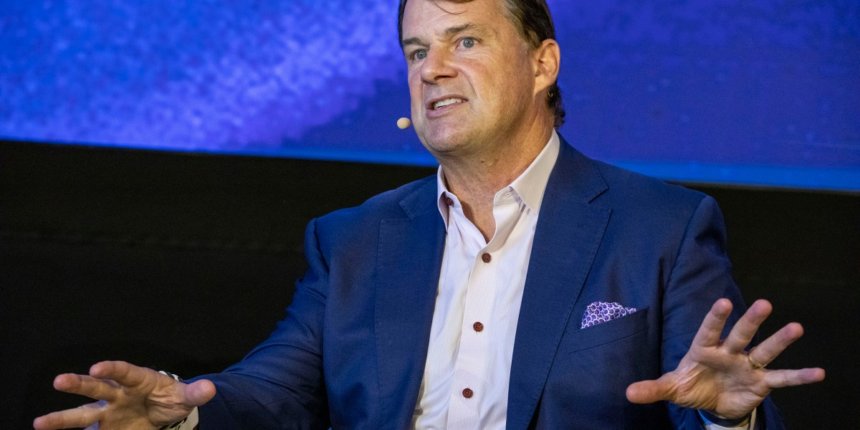
But during the keynote discussion with Labor Secretary Lori Chavez-DeRemer and Mike Rowe of the Mike Rowe Works Foundation, Farley revealed how his own family is being impacted. “My son worked as a mechanic this summer,” Farley said while moderating.
Then, Farley added, his son said something that stunned both of his parents: “Dad, I really like this work. I don’t know why I need to go to college.” Farley said he and his wife looked at each other and wondered, “Should we be debating this?” It’s something that’s happening in a lot of American households, he noted. “It should be a debate.”
Rowe, a longtime vocational advocate, seized on data showing that while two skilled tradespeople enter the workforce, five retire each year. The imbalance, he explained, is “the math that’s catching up to us” as the baby boomer generation ages and birth rates fall.
Rowe cited data from his own life. His own degree cost $12,200 in 1984, he said, whereas today it would cost something like $97,000.
“Nothing in the history of Western civilization has gotten more expensive, more quickly,” Rowe said. “Not energy, not food, not real estate, not even health care, [nothing has been inflated more] than the cost of a four-year degree.”
“Our youth want to know why. Why do I need to go to college? Why do I want to get in debt? Why do I want to do these things?” She said that “because I told you so” doesn’t cut it anymore.
Labor Secretary Chavez-DeRemer echoed this sentiment, saying government, educators, and industry must partner to make the skilled trades attractive to young Americans.
“For far too long, we haven’t brought the right people to the table,” she said, emphasizing the need for collaboration so that “businesses are heard, and the American workforce is valued.”
Chavez-DeRemer argued that if the average American wants to have a good-paying job and a mortgage, they should strongly consider the trades.
She questioned: “Do you know that most of our 35- and 40-year-olds are not going to be able to buy a home anywhere near the future?”
The essential obstacle, said Rowe, is not just economics but stigma.
“Stigmas and stereotypes and myths and misperceptions have conspired to keep a whole generation of kids from giving trades an honest look,” he said. Until the culture changes and people recognize the dignity and opportunity of these jobs, attempts to fill workforce gaps will be “quixotic or Sisyphean.”
Asked about the fear AI and robotics might replace human workers, both panelists were optimistic. Chavez-DeRemer compared the transition to prior industrial and tech revolutions, stating: “We adapt. We are an adaptable people.” She emphasized AI should be seen as a tool that empowers, not replaces, the essential workforce.
“Businesses are retraining their employees,” she said. “The R&D is showing us that [they’re] going to create new types of jobs.”
“The biggest CEOs in our country [are ringing] the metaphorical alarm bell,” Rowe said, calling it a “macro problem” the essential economy can solve.