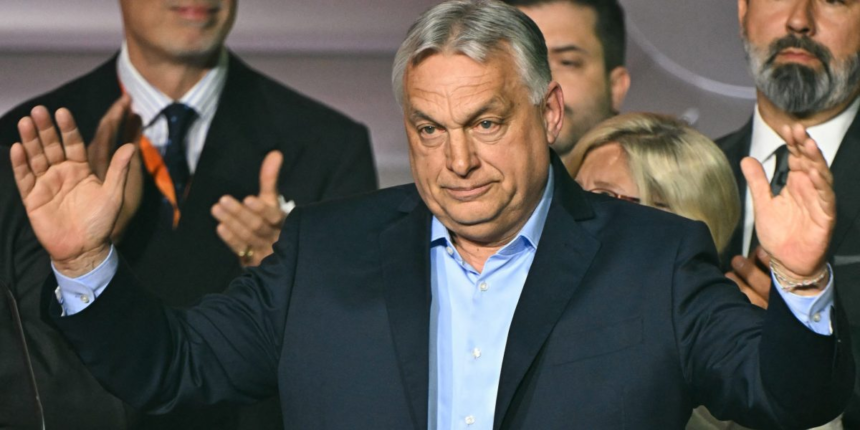
Election victor Péter Magyar, a former Orbán loyalist who campaigned against corruption and on everyday issues like health care and public transport, has pledged to rebuild Hungary’s relationships with the European Union and NATO — ties that frayed under Orbán. European leaders quickly congratulated Magyar.
It’s not yet clear whether Magyar’s Tisza party will have the two-thirds majority in parliament to govern without a coalition. With 77% of the vote counted, it had more than 53% support to 38% for Orbán’s governing Fidesz party.
“I congratulated the victorious party,″ Orban told followers. “We are going to serve the Hungarian nation and our homeland from opposition,″ he said.
Turnout by 6:30 p.m. was over 77%, according to the National Election Office, a record number in any election in Hungary’s post-Communist history.
The parties of both Orbán and Magyar said they had received reports of electoral violations, suggesting some results could be disputed by both sides.
“I’m asking our supporters and all Hungarians: Let’s stay peaceful, cheerful, and if the results confirm our expectations, let’s throw a big, Hungarian carnival,” Magyar said.
Mark Radnai, Tisza’s vice president, also called for reconciliation after a tense campaign. “We can’t be each other’s enemies. Reach out, hug your neighbors, your relatives. It’s the day of reunification.”
The EU will be waiting to see what Magyar does about Ukraine. Orbán repeatedly frustrated EU efforts to support Ukraine in its war against Russia’s full-scale invasion, while cultivating close ties to Putin and refusing to end Hungary’s dependence on Russian energy imports.
Recent revelations have shown a top member of Orban’s government frequently shared the contents of EU discussions with Moscow, raising accusations that Hungary was acting on Russia’s behalf within the bloc.
Orbán occupied an outsized role in far-right populist politics worldwide.
Casting his ballot in Budapest, Marcell Mehringer, 21, said he was voting “primarily so that Hungary will finally be a so-called European country, and so that young people, and really everyone, will do their fundamental civic duty to unite this nation a bit and to break down these boundaries borne of hatred.”
He also heavily strained Hungary’s relationship with the EU. Although Hungary is one of the smaller EU countries, with a population of 9.5 million, Orbán has repeatedly used his veto to block decisions that require unanimity.
Magyar, 45, rapidly rose to become Orbán’s most serious challenger.
Tisza is a member of the European People’s Party, the mainstream, center-right political family with leaders governing 12 of the EU’s 27 nations.
Magyar faced a tough fight. Orbán’s control of Hungary’s public media, which he has transformed into a mouthpiece for his party, and vast swaths of the private media market give him an advantage in spreading his message.
The unilateral transformation of Hungary’s electoral system and gerrymandering of its 106 voting districts by Fidesz also will require Tisza to gain an estimated 5% more votes than Orbán’s party to achieve a simple majority.
Additionally, hundreds of thousands of ethnic Hungarians in neighboring countries had the right to vote in Hungarian elections and traditionally have voted overwhelmingly for Orbán’s party.
Such accusations are part of why many in the EU see Orbán as a danger to the bloc’s future.