Southeast Asia’s motorists are increasingly feeling the pinch as the Iran energy crisis extends into its eighth week. Fuel prices have soared across the region, and drivers are waiting in long lines outside petrol stations in Thailand, Vietnam, and the Philippines, hoping to fill their tanks.
While oil prices have slipped from their highs just a few weeks ago—West Texas Intermediate crude is currently hovering around $90 per barrel—they are still far above prewar levels. The closed Strait of Hormuz, as well as export bans of refined fuel products from countries like China and South Korea, have cut off petrol supplies in Asia.
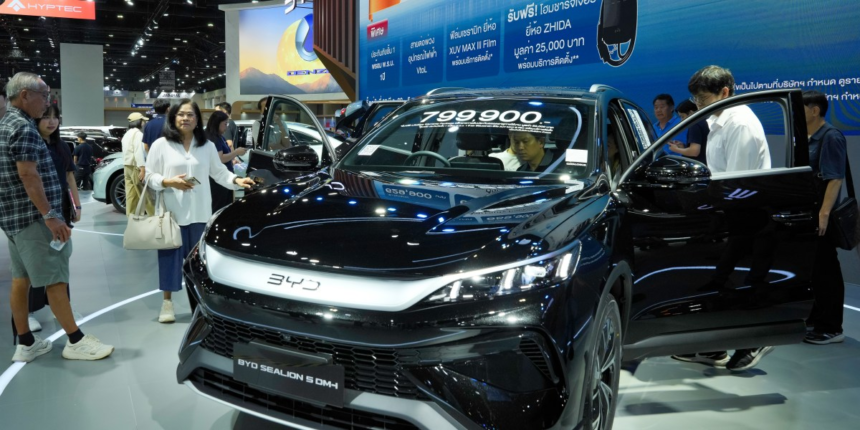
But across the region, drivers may have found an answer: electric vehicles.
Energy security concerns are shaping EV demand, says Samuel Chng, a research assistant professor at the Singapore University of Technology and Design (SUTD). “EVs are increasingly framed not just as a climate solution, but as a way to reduce dependence on imported energy.”
“The energy crunch is doing much more to accelerate the EV transition than any message on climate change,” said Lawrence Loh, who heads the Center for Governance and Sustainability at the National University of Singapore (NUS). “Ultimately, it’s about what hits your pocket—and the Iran war hits your pocket right away.”
“Asian EV makers appeal to consumers by offering more features at the same price,” said Kim Jeong Won, a senior fellow at NUS’s Energy Studies Institute.
Local EV manufacturers are benefiting as well. VinFast sold just over 175,000 EVs in its home market last year, doubling its 2024 figure. EVs now make up almost 40% of Vietnam’s car sales, overtaking the EU average, according to energy think tank Ember.
Experts cautioned that EVs won’t fully solve problems around the green transition and energy security. “The overall climate benefit of EVs depends on how clean a country’s electricity grid is,” said Chan of NTU. “Otherwise, emissions are simply shifted upstream.” (Southeast Asia still relies heavily on fossil fuels like coal for power generation.)
“When you think about the life cycle costs—which consider all the factors from the time you purchase a car to when you give it up, such as insurance and longevity—EVs might ultimately cost more per mile than gasoline vehicles,” said Li.