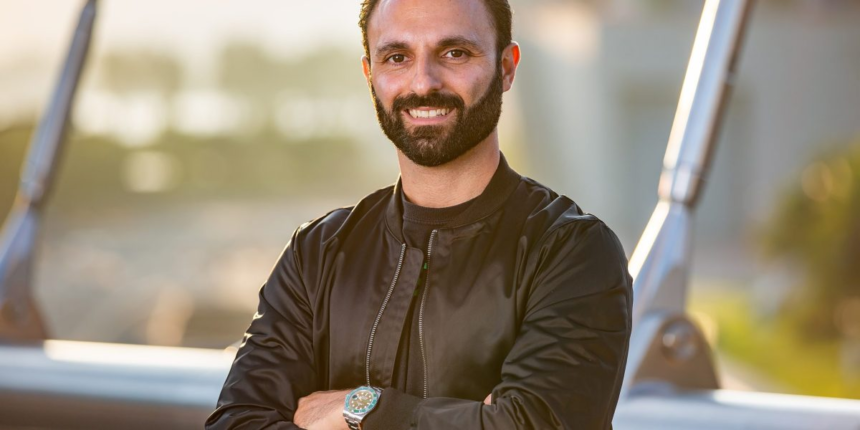
Ardy Arianpour fled Tehran at six years old with his family and four suitcases. Forty years later, he’s helped scale a $1 billion acquisition, saved his father’s life with his own technology, and built a health data platform sitting on 150 million patient records.
The 46-year-old founder and CEO of Seqster grew up in San Diego, the city his family landed in when they escaped war in Tehran in 1986.
But his big break didn’t come from a stock windfall. After studying biological sciences at university and then getting an MBA from the Marshall Goldsmith School of Management, he spent years scaling Ambry Genetics as its senior vice president, where he led its $1 billion acquisition by Konica Minolta—and earned so much in the process he could have retired.
“After my success at Ambry, I honestly didn’t have to work anymore and could have sat on a beach for the rest of my life,” Arianpour tells Fortune. Instead, he founded Seqster.
The idea was straightforward: critical patient data exists everywhere in health care, but it’s fragmented across systems and almost never in one place when it matters most. What he didn’t expect was how quickly it would become personal. Shortly after launching in 2016, his father was diagnosed with colon cancer. Using Seqster, Arianpour pulled together his father’s scattered medical records, assembled a team of specialists, and had a treatment plan in place within six hours. His father was in surgery within a week.
“That’s when it became clear,” he adds. “This wasn’t just a data platform. It was a way to turn fragmented information into actionable, life-saving insight.”
It happened again when his wife experienced severe heart rhythm episodes and was told that specialist care could take nine months. He used Seqster to consolidate her records, accelerate access to the right doctors, and secure surgery within weeks.
—
Being in the C-suite is a high-pressure job with long hours, board responsibilities, and intense scrutiny. But what is it like to be a top executive when you’re off the clock? Here’s what he told us.
What’s the best financial decision you’ve ever made—and how much did it make or save you?
The best investment I ever made was in Seqster itself. I put my own money in when no one else would, because I believed in what we were building. That conviction cost me sleep and savings, but there is nothing I would do differently.
And the worst?
The most valuable thing is time and the worst investment was spending time with big tech companies and getting nothing in return.
What’s in your wallet?
I have a picture of my wife, a fortune from a Panda Express cookie (I am super superstitious) and I always have a $100 bill for emergencies—my Dad taught me to always keep $100 in case you can’t use credit cards. My go-to credit card is Chase Sapphire Reserve. It has the best perks for airport lounges and hotels since I travel for work every week.
Do you invest in shares?
My best advice for newbies is to invest 10% of your earnings into the S&P 500 and precious metals and don’t touch it.
What personal finance advice would you give your 20-year-old self?
Don’t worry about the future. Take major risks. It is OK to fail and learn. Live your best life and do your best work.
What are your living arrangements like: Swanky apartment in the city or suburban sprawling?
I’m a full-on city slicker, living in the sky above San Diego, soaking in skyline lights on one side and ocean views on the other.
I love Top Gun, so I put our offices off Miramar Road where I started the company.
What does your morning routine actually look like—be honest?
I keep it pretty simple. I’m usually up early at 5 a.m., check anything urgent, get a quick workout or run in, and then get into the day.
I don’t want to think about what I am going to wear for work, so I created our uniforms 10 years ago. I wear a Seqster shirt, Seqster hat, and Seqster “Converse”.
How much do you spend each day on your caffeine hit?
$0 on caffeine unless I have a Coke with my In-N-Out burger, animal style. I never drink coffee. Instead, I only drink acai and carrot juice. Those cost me an arm and a leg ($500/month) since I am addicted to running on juice!
What about eating on the go?
I only eat lunch if it is a lunch meeting. Otherwise, I skip lunch and have big dinners. On the go, I always have a protein bar.
Where do you buy groceries?
Whole Foods. On weekends, I will sometimes go to a farmers’ market near us.
We spend somewhere around $300 to $400 a week on food. I never do online shopping, I can’t stand someone picking my fruits and veggies, they never get it right! I only buy fresh products and we cook the food that day. Almond butter helps me be on my A-Game, always in my cart!
How often in a week do you dine out versus cook at home?
For business meals, I am probably out two or three times a week. But we cook at home if I am home—and I never like eating out during the week. When we do go out it tends to be for something worth the occasion: a nice dinner, something to celebrate.
What’s the 5-to-9, after your 9-to-5 look like?
I usually wrap up around 7 p.m., I am in bed by 1 a.m., and I average somewhere around 60-70 hours a week of work. I try to make the hours count rather than counting the hours. I play my XBox to zone out of reality and have fun. My favorite games are Forza 6, which is an incredible photorealistic open-world race game, and of course, I love Call of Duty and have always been a die-hard Halo player since purchasing my first original XBOX in 2001.
How do you unwind from the top job?
I run. There is something about being outside and moving that clears my head in a way nothing else does. No headphones sometimes, just the city and my thoughts.
What’s your take on work-life balance at the top?
I think the framing of “balance” is wrong. It implies a static equilibrium, and that is not what a founder’s life looks like. There are seasons. There are weeks where work takes everything, and there are weekends where I protect personal time fiercely.
What’s the one subscription you can’t live without?
Are you the proud owner of any tech gadgets?
My Apple Watch. I have had one for years and at this point it feels like a body part. I use it for everything: tracking workouts, monitoring sleep, staying on top of messages without pulling out my phone every five minutes.
How do you celebrate a big win? Do you still treat yourself when you hit a career milestone?
When we hit a major company milestone, I take my wife to dinner somewhere genuinely special. Not just a nice restaurant, a dinner with a reservation we had to plan for. That ritual matters to me. It marks the moment.
What’s the most expensive bonus treat you’ve bought yourself?
A watch. I bought myself and my team green Hulk Rolexes when Seqster was formed. It cost more than I want to admit in print. No regrets at all. It is on my wrist right now.
How many days annual leave do you take a year? And do you ever truly switch off?
I don’t remember the last time I took a day off. There are always 10 text messages, 10 emails, a phone call or two. Even on New Year’s Day, we closed a deal.
Take us on holiday with you, where did you go this year?
Most of my travel is for work, and I will be honest, I have gotten pretty good at squeezing the most out of it. If I am in Europe for a conference I will tack on an extra day or two and actually see somewhere. I love Ibiza, the best music and the energy there is unlike anywhere else, and the food is extraordinary. It is not exactly a traditional vacation but it works for us.