“We’re being distracted, obviously, by all the media that’s going on at the moment,” Sage told Fortune in a Jan. 20 interview.
“In one way, it’s good, because obviously a lot of people now are realizing how big Tanbreez is and how important it is strategically for the U.S. But it’s bad that it creates uncertainty with the local people. You’ve seen the protests about what’s happening,” Sage said. “There is a little trepidation in Greenland with our local partners and our staff. It’s not causing us any delays right now, but if things escalate, that might cause us some delays.
“We don’t want to be used as a political football,” he added.
Many thousands have rallied and protested within Greenland and in Denmark, chanting: “Greenland is not for sale.” Trump is demanding to buy Greenland—with costs estimated up to $700 billion—or take it by force, and he’s enacting new tariffs on Denmark and the rest of the EU to create leverage. The president cites national security concerns—despite existing approvals to expand militarily—and the potentially rich natural resources on the icy, largely barren territory.
“An independent Greenland, but with a heavy U.S. defense presence, would be the ideal situation,” Sage said, citing a potential referendum for Greenland independence from Denmark. “I don’t know whether that’s going to happen, but I think that’s the best of both worlds.”
“We’re all hands on deck,” Sage said. “We’re going 100 miles an hour doing what we do and just ignoring the political stuff for now.”
Australian geologist Greg Barnes, who founded the Tanbreez project, was among the first to tout Greenland to Trump when they met in 2019 at the White House.
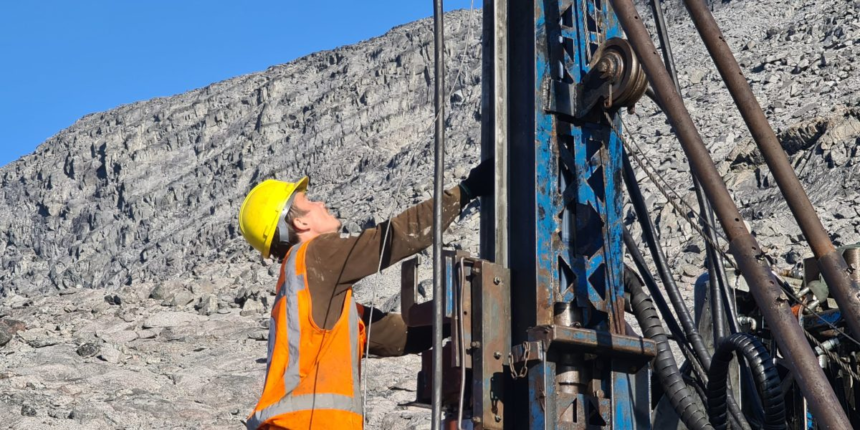
Last year, Critical Metals increased its stake in Tanbreez and now owns 92.5% of it. Preconstruction activities and a pilot project are getting underway, although full construction isn’t expected to begin until spring 2027 with completion slated for late 2028.
Sage touts Tanbreez’s potential not only for its high concentration of rare earths, but also for its larger percentage of the rarer, heavy rare earths, especially terbium and dysprosium, and other valued rare earths, such as hafnium, gallium, and niobium. (Most rare earths aren’t rare; they’re just hard to find in high concentrations that are economically feasible to extract.)
Tanbreez theoretically offers easier access via an open pit—it’s not underground—and the rarer critical minerals that China can’t easily dump on the market at low prices to tank the competition, Sage said.
The goal is to mine close to nearly 1 million metric tons of ore per year, Sage said, and the mine has enough deposits to maintain that pace for more than a century.
“I don’t think people understand the gravity,” Sage said. “Within three years, we’ll reduce China’s heavy rare earths supply [control] from 97% to about 50%.”