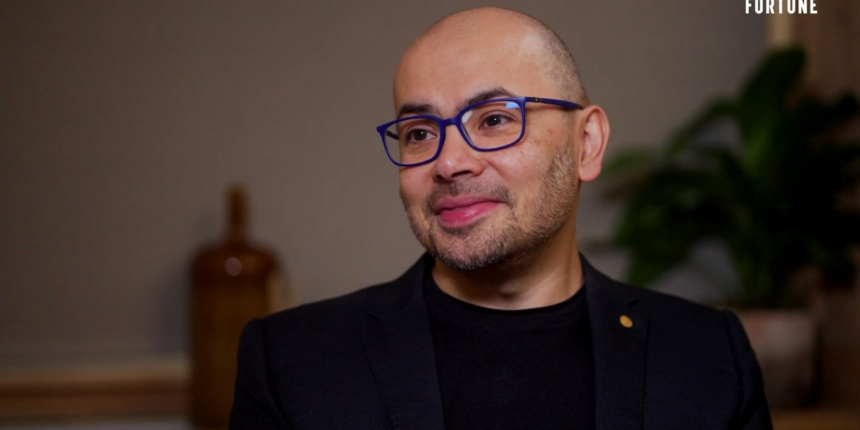
“In 10, 15 years’ time, we’ll be in a kind of new golden era of discovery that [is] a kind of new renaissance,” Hassabis predicted. In this near future, he predicted that “medicine won’t look like it does today,” with AI enabling personalized treatments and curing major diseases. Beyond health, he said he foresees AI unlocking new materials to solve the energy crisis through fusion or solar breakthroughs, eventually allowing humanity to “travel the stars and … explore the galaxy.”
“If we don’t disrupt ourselves, someone else will,” Hassabis said. “You’re better off … doing it on your terms.”
The consolidation was necessary to pool the “enormous compute power” required to train frontier models like Gemini. The strategy appears to be working; following the release of models such as Gemini 3 and the viral image generator Nano Banana, Google parent Alphabet’s shares soared approximately 65% by the end of the year. Hassabis said he thinks the company has now “crossed the watershed moment” where AI models are capable enough to act as useful assistants in high-level research.
The cornerstone of this new era, according to Hassabis, is the application of AI to biology. He pointed to AlphaFold, DeepMind’s breakthrough model that solved the 50-year-old “protein folding problem,” as the proof of concept. By predicting the 3D structure of over 200 million proteins, the system has provided a road map for the human body that is now used by over 3 million researchers. (This is the work that led to Hassabis being awarded the Nobel Prize in Chemistry in 2024.)
This “renaissance” requires relentless effort, though. Hassabis admitted that he “doesn’t sleep very much,” working a “second day” from 10 p.m. to 4 a.m. to focus on deep scientific thinking. “I come alive at about 1 a.m.,” he confessed.
For Hassabis, the grueling schedule and the corporate restructuring are table stakes for the ultimate prize. The next decade may be a period of intense technological shakeout and adaptation, but he said he remains convinced of the destination. “We set out with the mission of … solving intelligence and then using it to solve everything else,” Hassabis said. If his 15-year timeline holds true, “everything else” may soon include the stars themselves.