You tap your phone and a stranger appears at your door with your groceries. You click through a cash back portal and a package of clothes arrives two days later. These transactions feel effortless—and that effortlessness is entirely manufactured by a layer of operational leaders whose actual job is to make sure you never think about them at all.
But right now, those leaders are telling a different story, and that’s because they’re exhausted.
Down Coulson has a name for what she’s observing across the C-suites she works in and around, a concept she calls “reinvention exhaustion.” It’s something more specific and more structural than just burnout. “The same leaders who are being tasked with this reinvention and total transformation today are the same ones that led companies through massive restructurings, COVID-19, all the geopolitical stress and strife,” she said. “Not a lot of time in between to breathe.” They never got to recover, instead absorbing the next thing. And now the next thing is the biggest ask yet, whether everything they built their careers on is still relevant at all.
COVID asked leaders to execute under extreme pressure. AI is asking them to question whether the way they’ve led and the skills they’ve spent careers building are still relevant at all.
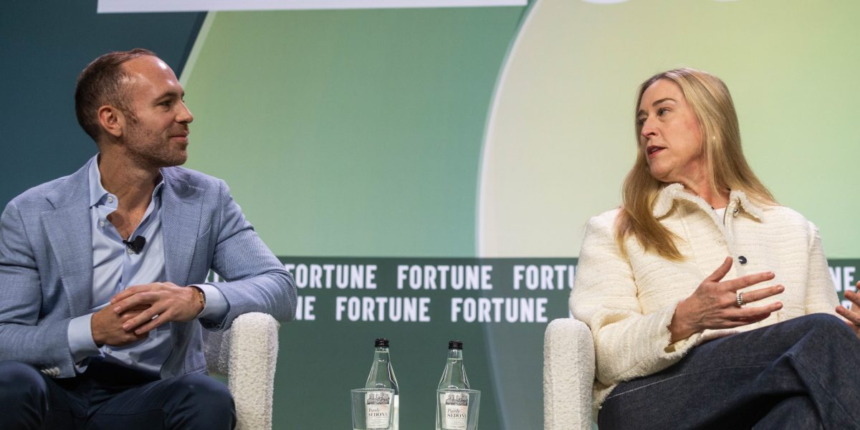
Both executives operate above the day-to-day. Down Coulson oversees multiple business units at Rakuten, each with its own C-suite. Maguire sits atop a live operations infrastructure handling millions of grocery orders daily. Their actual work is less about running functions than about orchestrating the executives who do—managing where decisions stall, where trust breaks down between peers, where organizational gears start to grind.
And for years, the way that grinding got managed was by absorbing it. Down Coulson offered one of the most candid admissions of the panel when she turned the lens on herself.
“I have been an absorber of friction,” she said. “And that’s removing it from the other people around the table, but it doesn’t get rid of it. It doesn’t fix it.”
Under normal conditions, friction absorption works well enough. But these are not normal conditions, haven’t been for years and show no sign of normalizing soon.
Meanwhile, the operational complexity underneath those frictionless consumer experiences keeps growing. Instacart customers now expect real-time, personalized substitutions when their preferred items are out of stock—not whatever’s nearest on the shelf, but the right replacement, drawn from their own purchase history and surfaced to a shopper standing in the aisle in seconds. “AI is raising the bar,” Maguire said. “It’s making customers have a set of expectations around speed, around personalization, even better and stronger.”
Maguire’s prescription for exhaustion is to stop iterating and commit to transformation wholesale—skip to the end, move the metric 40 points instead of one, give teams something worth running toward instead of an endless treadmill of marginal gains.
“The companies that win at the end of the day are not going to be those that pick one technology over another,” she said. “But really the ones that face the hard calls at that leadership level.”
The elves are tired. The magic still has to happen. Something has to give.
For this story, Fortune journalists used generative AI as a research tool. An editor verified the accuracy of the information before publishing.