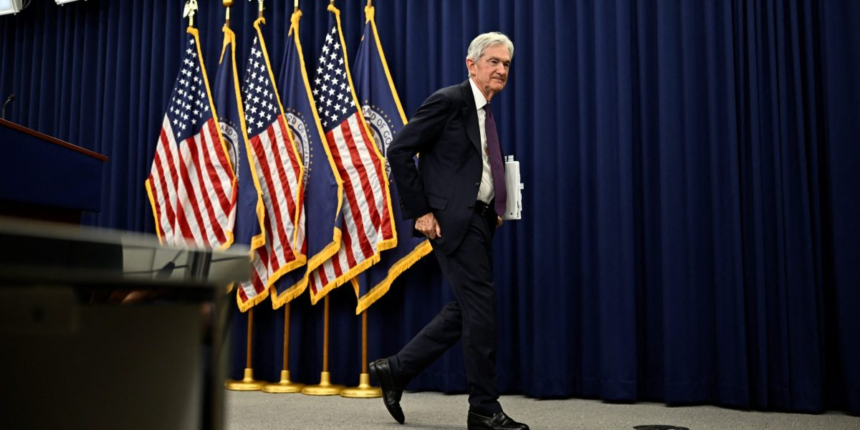
“I give him two grades,” Hilsenrath told Fortune after Powell’s conference. On managing the institution and representing it publicly, “I think he gets high marks.” Powell, he said, “managed the place through a deal of turbulence, and the most significant that we’ve seen ever.”
Indeed, he faced a pandemic that shut down the global economy, the fastest tightening cycle in 40 years, a regional banking panic, and a sitting president who called him everything from a “numbskull” to a “loser” while floating his firing on a near-weekly basis.
Throughout it all, Powell steered the Federal Open Market Committee to mostly unanimous decisions, building consensus across 11 other central bankers who almost certainly didn’t agree with him or each other. He kept his public language careful enough that markets could hear him without panicking. And when Trump’s attacks escalated into legal action this spring, Powell responded swiftly and strongly in a calm video message rather than on cable news. “I think he went about his business with integrity and goodwill,” Hilsenrath said.
That’s the first grade. The second was a bit harsher.
“On the economics, frankly, I don’t think he was very good at it,” he said. “I think they made a lot of mistakes under his leadership, on the economics and the monetary policy.”
Hilsenrath’s core charge is that Powell, shaped by his years at the Fed during the Great Financial Crisis, mismanaged the COVID crisis by reaching for the same tools. “It was a supply shock, and they responded to the crisis using policies that were formulated the decade before to deal with a demand shock,” he explained.
During the pandemic, the Fed launched massive bond-buying programs, cut rates to zero, and promised to keep them there, flooding the economy with cash and stoking inflation.
Another mistake was timing. When inflation finally began to move up in 2021, the Fed was slow to respond. Hilsenrath pointed to a specific Powell line that, in retrospect, captured the freeze: “I don’t even want to talk about talking about it.”
He said it at his June 2021 press conference, when reporters pressed him on whether the Fed should start discussing winding down its bond purchases. The phrase was a deliberate signal, Hilsenrath said: Powell had lived through the 2014 “taper tantrum,” when bond markets panicked at the mere mention of the Fed slowing stimulus, and he was determined not to repeat it. So he refused to even open the conversation. But by the time the FOMC started raising rates nine months later, inflation was already at 7.9%.
“Powell saying, ‘I don’t even want to talk about talking about it’ was an example of him not recognizing that this moment was different and they had to respond in a different way,” Hilsenrath said.
Powell did eventually recognize it. His August 2022 Jackson Hole speech—which was the most hawkish in decades—embraced the “pain” of breaking inflation. But by then, it was too late.
Six years after Covid, inflation remains above the Fed’s 2% target. To be fair, Powell continued to weather a series of additional inflationary shocks, such as Russia’s war in Ukraine, two rounds of Trump’s tariffs, and the U.S.-Israeli war against Iran.
But Hilsenrath sees those shocks as a symptom of “a deeper disease” Powell missed, namely the unwinding of decades of hyper-globalization that perennially kept goods cheap. Hilsenrath thinks it was a mistake to keep treating each shock as a one-off it could look through.
“I don’t think you could give him high marks on the economy when they’ve failed to hold inflation to their stated goal for so long,” he said. “The 2% inflation target is sacred and balanced of what all central banking should be about.”
While that part of his legacy is more or less settled, Powell confirmed he’ll stay on as a Fed governor until 2028—the first outgoing chair to remain on the board since Marriner Eccles in 1948. Powell framed the decision as a response to the legal attacks on the institution, but Hilsenrath reads it as something more strategic.
By staying, Powell denies them those chances. Even if he leaves after a few months, he’ll have bought the institution time for the legal challenges to play out and the political climate to shift.
“Powell is effectively saying he’s not going to hand over a critical seat to a president who he still thinks is a threat to the independence of the institution,” Hilsenrath said. “That’s his line in the sand.”