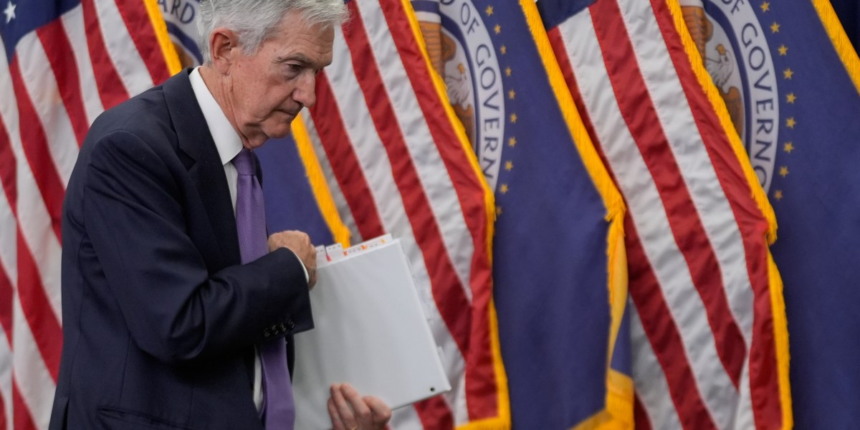
What was once seen as a near-certain cut in interest rates next month now looks more like a coin flip as Federal Reserve officials sharply disagree over the economy’s health and whether stubborn inflation or weak hiring represent a bigger threat.
The turmoil on the Fed’s 19-member interest-rate setting committee reflects a deeply uncertain economic outlook brought about by multiple factors, including tariffs, artificial intelligence, and changes in immigration and tax policies.
“It’s reflective of a ton of uncertainty,” said Luke Tilley, chief economist at M&T Bank. “It’s not surprising at all that there’s a wide divergence of opinions.”
Four dissenting votes would be highly unusual, given the Fed’s history of seeking consensus. The last time four officials dissented was in 1992, under then-Chair Alan Greenspan.
Fed governor Christopher Waller on Monday noted that critics of the Fed often accuse it of “group think,” since many of its decisions are made unanimously.
“People who are accusing us of this, get ready,” Waller said Monday in remarks in London. “You might see the least group think you’ve seen … in a long time.”
After cutting their key rate in September for the first time this year, Fed policymakers signaled they expected to cut twice more, in October and December.
And speeches last week by a raft of regional Fed officials pushed the market odds of a December cut even lower. Susan Collins, president of the Federal Reserve Bank of Boston, said, “in all of my conversations with contacts across New England, I hear concerns about elevated prices.”
Collins said that keeping the Fed’s key rate at its current level of about 3.9% would help bring inflation down. The economy “has been holding up quite well” even with interest rates where they are, she added.
Several other regional presidents voiced similar concerns, including Raphael Bostic of the Atlanta Fed, Alberto Musalem of the St. Louis Fed, and Jeffrey Schmid at the Kansas City Fed. Musalem, Collins, and Schmid are among the 12 officials who vote on policy this year. Schmid dissented in October in favor of keeping rates unchanged.
“When I talk to contacts in my district, I hear continued concern over the pace of price increases,” Schmid said Friday. “Some of this has to do with the effect of tariffs on input prices, but it is not just tariffs — or even primarily tariffs — that has people worried. I hear concerns about rising health care costs and insurance premiums, and I hear a lot about electricity.”
On Monday, however, Waller argued that sluggish hiring is a bigger concern, and renewed his call for a rate cut next month.
“The labor market is still weak and near stall speed,” he said. “Inflation through September continued to show relatively small effects from tariffs and support the hypothesis that tariffs … are not a persistent source of inflation.”
Waller also dismissed the concern — voiced by Schmid and others — that the Fed should keep rates elevated because inflation has topped the Fed’s 2% target for five years. So far that hasn’t led the public to worry that inflation will stay elevated for an extended period, Waller noted.
“You can’t just sort of say it’s been above target for five years, so I’m not going to cut,” he added. “You got to give us better answers than that.”
There could be consensus for an interest rate cut if, say, new data for October and November show the economy shedding jobs, according to Esther George, the former president of the Kansas City Fed.
“Registering a dissent is a hard decision, and I think you’re going to find people that are speaking today that wouldn’t follow through with a vote in that direction,” she said. “I think you’re going to find enough consensus, whichever way they go.”