For the founders of JetStream Security, a San Francisco-based startup built by veterans of CrowdStrike, SentinelOne, and Cohesity, it’s an example of the problem they’re trying to solve. Companies are racing to deploy AI agents and custom-built models, but most have no way to map what those systems are doing, no inventory of unauthorized AI tools their employees are quietly running, and no kill switch for when something goes wrong.
JetStream’s answer is built around a feature called AI Blueprints—real-time graphs that map everything an AI system is doing inside an organization at any given moment. Each Blueprint traces the full chain of activity: which agents are running, which models they’re using, what data and tools they are interacting with, and who or what is behind each action. Rather than a static snapshot, Blueprints track live behavior, so if an AI system starts acting outside its intended purpose, the platform flags it. They also track cost, showing what each AI workflow is spending and who is responsible for it.
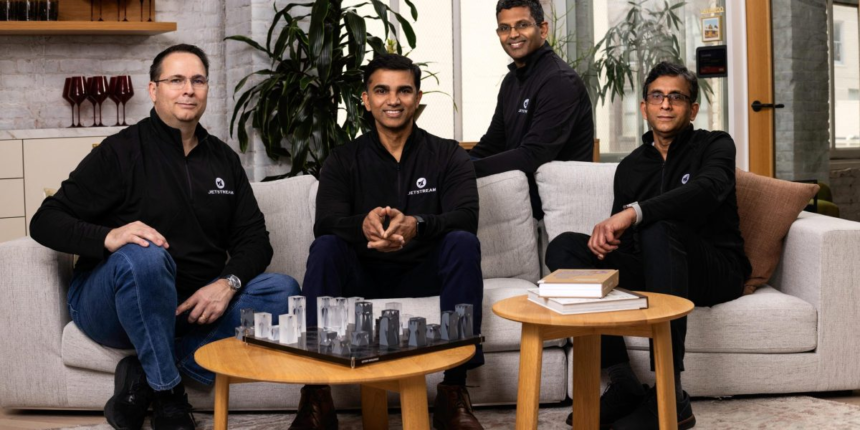
The company, founded by Raj Rajamani, Jared Phipps, Jatheen “AJ” Anand, and Venu Vissamsetty, has already raised $34 million in seed funding in a round led by Redpoint Ventures, with participation from the Falcon Fund, and investors including CrowdStrike CEO George Kurtz, Wiz CEO Assaf Rappaport, and Okta Vice-Chairman Frederic Kerrest.
Concerns about security risks are a big factor holding back AI adoption by large businesses. Companies are wary about encouraging staff to experiment with tools or let a “black box” system have access to years of data.
“AI adoption is not a technology challenge, it’s a trust challenge,” Rajamani told Fortune. “Leaders are being asked to bet their businesses and careers on systems they can’t fully see, explain, or control. That’s where trust breaks down.”
Phipps said JetStream’s early customer work suggests the reality is usually worse than they think. One thing he said he sees regularly is employees inadvertently pasting sensitive company data into a personal ChatGPT or Claude account, instantly placing proprietary information outside the business’s control. The same risk extends to developers, who routinely download AI plugins directly from the internet without IT’s knowledge, often bringing security vulnerabilities in with them.
“They put their whole life into building a business,” he said of business owners, “and in one mistake, they can lose core aspects of it.”
JetStream already has around 40 employees and says it’s seeing strong interest from a broad range of organizations—from small FinTech firms to global banks, airlines, and other Fortune 500 companies. The company plans to deploy the new funds raised across its engineering, product, and go-to-market teams.
“By the time you notice AI isn’t working perfectly in your business, the damage has already been done,” Phipps said, dismissing the potential for future competition. “Everybody needs to be focusing on governance. Frankly, everybody should care — because everybody has risk.”