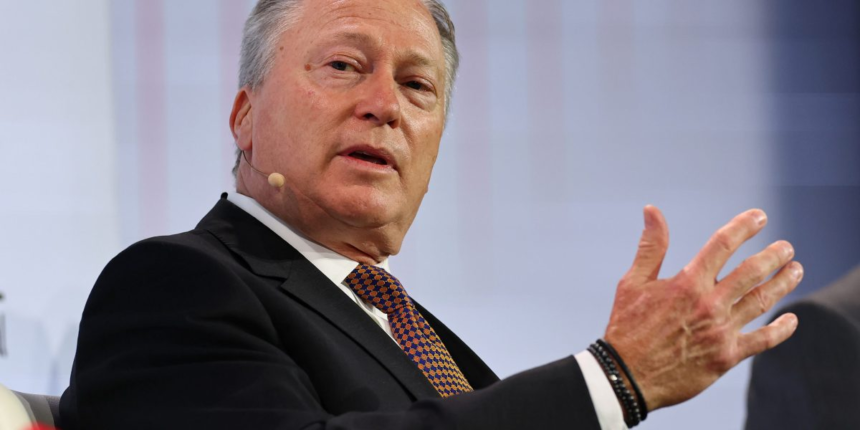
With assets that span renewables to utilities, Enbridge boasts a broad array of businesses that’s matched by the lofty role it sees itself playing on the world stage. Enbridge—whose name is a contraction of energy bridge—is committed to keeping the economic and cultural bonds between North America’s neighbors strong and healthy; it doesn’t hurt that CEO Greg Ebel, a dual citizen, is an unofficial diplomatic whisperer to the White House and Canadian Prime Minister Mark Carney helping to ease tensions between the two.
“We want to be the first choice for energy delivery in North America and beyond,” Ebel said, sitting down with Fortune.
“One of the unfortunate—but positive for North America—outcomes of this Middle East situation will be a greater recognition that there’s less of a risk premium needed in North America,” Ebel said. “I think that’s an upside for Canada and the United States and for infrastructure players like us.”
“We like being part of that North American energy dominance play,” he said. “The company, by design, is bi-cultural.”
Ebel even alternates between hockey and baseball metaphors. Looking at projected growth for renewables, natural gas, and oil exports, he said Enbridge “skated to the puck in multiple areas.”
And, focusing on infrastructure expansions and modest acquisitions, he added, “You’re not going for home runs; you’re going for singles and doubles.”
“In all of our businesses, both on the renewable side and the gas distribution and transmission side, we are hooking up or building projects for data centers for AI,” Ebel said.
A native of Ottawa, before entering the energy sector, Ebel worked in the Canadian government and then with the World Bank in Washington, gaining a sharp literacy in North American politics.
That early career experience is serving him well now. From President Donald Trump’s tariffs on Canada and repeated taunts about making Canada the 51st state, Ebel has managed to help keep Canadian oil above the fray.
“There have not been, nor do I believe there will be, discussion of tariffs on Canadian energy coming south,” Ebel said, noting how crude oil is excluded from the tariffs. “It’s too important to energy dominance.”
He acknowledged he’s taking a lot more phone calls these days from the Trump and Carney administrations, the latter of whom is moving the Liberal Party to support more oil and gas pipelines. And Ebel is happy to help bridge any gaps between the two countries.
“Trade tensions are always going to be there,” Ebel said. “You’ve got big brother and little brother, but it is one North American family.
“I feel confident that symbiotic relationship will continue to be the ultimate driving force, despite whether we win or lose a gold medal in Olympic hockey, which is a sore point for a lot of Canadians,” he added with a laugh.
While the war in Iran is potentially placing more demand on North American oil and gas, the U.S. military operation in Venezuela to arrest former leader Nicolas Maduro potentially created more competition for Enbridge.
After all, the Canadian oil sands produce a heavier grade of crude, as does Venezuela. That could create more competition with the U.S. Gulf Coast refineries that are built to process a lot of heavier oil.
But Ebel isn’t concerned, he said. While it falls short of a “nothing burger,” he said, the refineries may end up desiring more heavy crude overall, which is good for Venezuela and Canada. And, if Venezuela produces more additional oil than anticipated, then that’s just more oil for Enbridge to export overseas, he said.
Calgary-based Enbridge got its start in 1949 as the Interprovincial Pipe Line Company (IPL). As the company expanded more into the U.S., IPL changed its name in 1998 to Enbridge.
Much of his career rise focused on natural gas, and that’s where Ebel sees the most bullish growth, both for global exports from the U.S. and Canada, and to power the AI boom. The Iran war is bolstering that argument even more.
“At least for a very long time, people will wonder about the security of supply from that [Middle East] region. I think that’s a real winner for North American LNG that is safe and secure,” Ebel said. “It seems like, if you look at the fundamentals—and we’ve been big believers—that the demand for LNG is going to be ferocious right through the 2030s.”
Within North America, Ebel also aims to take advantage of the largest surge of electricity demand in many decades, largely thanks to AI.
That means building or expanding gas distribution and pipelines to hyperscalers’ campuses or building new infrastructure to the integrated utility companies servicing the data centers. And Enbridge will even build renewable energy directly for hyperscalers, such as in Texas.
“If you can offer them lots of different choices, you’re probably going to be the winner in this arms race,” Ebel said. It helps to be agnostic to the energy sources and offer up everything for the customers to choose from, he said.
Scale matters, and Enbridge has the size to do just that, he said.
“North America is just in the catbird seat from both the oil and the gas perspective.”