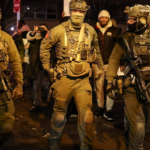
The largest anti-government demonstrations to rock Iran in recent years intensified Friday night, fueling fears of growing fatalities as authorities battle to suppress the protests.
Separate mobile-camera footage from Fardis, a city about 50 kilometers (31 miles) west of Tehran, showed at least seven bodies covered in blood inside a building. In the videos, people are seen bandaging the head and patching an eye of another individual, while a voice says at least 10 people were killed by gunfire. None of the footage could be independently verified by Bloomberg.
Security forces have arrested nearly 200 “leaders of terrorist groups,” seizing ammunition, hand grenades and Molotov cocktails, Tasnim reported Saturday, citing an informed security official. Iran’s prosecutor general warned that all detainees would be charged as an “enemy of God” — a broadly defined offense punishable by death under Islamic law in the country.
Mohammad Movahedi Azad said all “rioters” would face the same charge, “whether an individual has assisted rioters and terrorists” or “whether they are mercenaries who have taken up arms.” He said trial proceedings will be carried out without any delay and “without leniency, compassion, or indulgence,” the state-run IRIB News reported.
The protests over Thursday and Friday — Iran’s weekend — followed a call by Reza Pahlavi, the exiled son of the country’s former shah who’s positioning himself as an opposition leader. He urged demonstrators again to return to the streets after 6 p.m. local time on Saturday and Sunday.
Oman’s Foreign Minister Badr Albusaidi arrived in Tehran on Saturday, Iranian media reported. The visit comes amid rising tensions between the US and Iran over the Islamic Republic’s handling of protests, a day after Iranian Foreign Minister Abbas Araghchi said it was unclear whether Albusaidi was carrying “a message from anywhere.” Oman mediated five rounds of nuclear talks between Tehran and Washington last year, which stalled after US and Israeli attacks on Iran in June.
State TV played down the protests on Saturday, saying security forces had largely contained the demonstrations on Friday after what it described as unrest by “armed terrorists” in Tehran and other cities the night before.
Iran’s regular army signaled its loyalty to Supreme Leader Ayatollah Ali Khamenei, saying it will “monitor enemy movements in the region and firmly safeguard the nation’s interests, strategic infrastructure, and public property” under the 86-year-old leader, the semi-official Tasnim news agency reported.
Iranian authorities have so far refrained from releasing an official tally of fatalities among protesters or security forces. State-affiliated media reported at least a dozen deaths among police and Basij volunteer militia forces since Thursday. Tasnim said “armed terrorists” killed several police personnel in gunfire on Thursday.
Violence also broke out in Zahedan, a Sunni-majority city in south-western Iran and a long-standing flashpoint for deadly security incidents. The Norwegian-registered Hengaw Organization for Human Rights said security forces opened fire on demonstrators after Friday prayers, leaving several wounded.
State media published images of several burned buildings in Tehran, while a social media video purportedly showed a municipality building in Karaj, west of the capital, engulfed in flames.
Chants recorded in footage included “Death to the dictator,” “No Gaza, no Lebanon, my life for Iran,” and “This is the year of blood; Seyyed Ali will be toppled,” referring to Khamenei, who on Friday repeated his pledge to quash protesters.
While the US has so far been reluctant to embrace Pahlavi as a potential replacement for the Iranian government, President Donald Trump has warned the regime repeatedly against killing protesters.