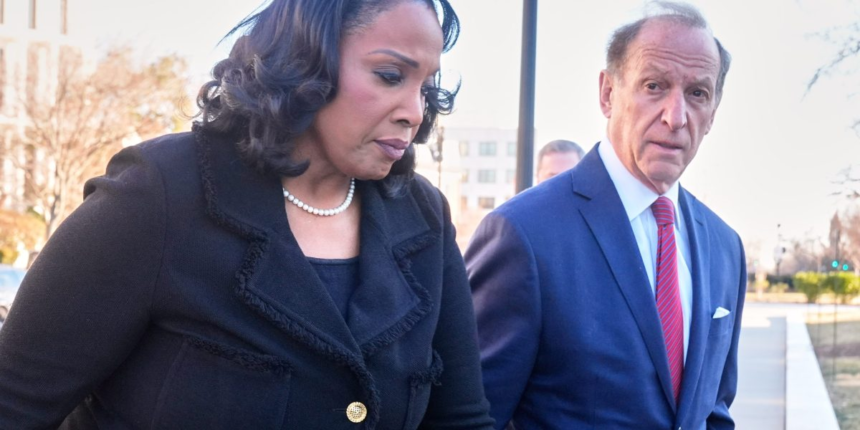
Allowing Cook’s firing to go forward “would weaken, if not shatter, the independence of the Federal Reserve,” said Justice Brett Kavanaugh, one of three Trump appointees on the nation’s highest court.
At least five other justices on the nine-member court also sounded skeptical about the effort to remove her from office.
“For as long as I serve at the Federal Reserve, I will uphold the principle of political independence in service to the American people,” Cook said in a statement issued after the arguments.
The true motivation for trying to fire Cook, Trump’s critics say, is the Republican president’s desire to exert control over U.S. interest rate policy. If Trump succeeds in removing Cook, the first Black woman Federal Reserve governor, he could replace her with his own appointee and gain a majority on the Fed’s board. The case is being closely watched by Wall Street investors and could have broad impacts on the financial markets and U.S. economy.
Trump has been dismissive of worries that cutting rates too quickly could trigger higher inflation. He wants dramatic reductions so the government can borrow more cheaply and Americans can pay lower borrowing costs for new homes, cars or other large purchases, as worries about high costs have soured some voters on his economic management.
During a speech earlier Wednesday in Davos, Switzerland, Trump reiterated his call for the Fed to sharply lower rates, arguing that the United States should pay “the lowest interest rate of any country in the world.”
Chief Justice John Roberts, who also seemed skeptical of Trump’s actions, suggested it may be pointless to return the case to lower courts rather than issue a more enduring ruling.
A decision is expected by early summer.
In Trump’s first year of his second term, the justices generally, but not always, went along with Trump’s pleas for emergency action to counteract lower-court rulings against him, including allowing the firings of the heads of other governmental agencies at the president’s discretion, with no claim that they did anything wrong.
But the court has sent signals that it is approaching the independence of the nation’s central bank more cautiously, calling the Fed “a uniquely structured, quasi-private entity.”
The case against Cook stems from allegations she claimed two properties, in Michigan and Georgia, as “primary residences” in June and July 2021, before she joined the Fed board. Such claims can lead to a lower mortgage rate and smaller down payment than if one of them was declared as a rental property or second home.
Those applications, Sauer said, are evidence of “gross negligence at best” and give Trump reason to fire her. In any event, he argued, courts shouldn’t be reviewing his decision and Cook has no right to a hearing.
Giving Cook a chance to sit down with Trump and respond to the allegations her, Justice Amy Coney Barrett said, “just wouldn’t be that big a deal, it seems.”
Cook has denied any wrongdoing and has not been charged with a crime. “There is no fraud, no intent to deceive, nothing whatsoever criminal or remotely a basis to allege mortgage fraud,” a Cook lawyer, Abbe Lowell, wrote to Attorney General Pam Bondi in November.
Cook specified that her Atlanta condo would be a “vacation home,” according to a loan estimate she obtained in May 2021. In a form seeking a security clearance, she described it as a “2nd home.” Lowell wrote that the case against her largely rests on “one stray reference” in a 2021 mortgage document that was “plainly innocuous in light of the several other truthful and more specific disclosures” about the homes she has purchased.
Roberts and Justice Sonia Sotomayor, both owners of multiple residential properties, expressed some sympathy for Cook.
“I suppose we can debate that, how significant it is in a stack of papers you have to fill out when you’re buying real estate,” Roberts said, responding to Sauer’s assertion that Cook had made a “quite a big mistake” in her mortgage application.
Sotomayor said there was something familiar to her in Cook’s need to move to Washington after her appointment to the Fed and rent out her Michigan home.
“I had to move from New York when I got my job in Washington, and, frankly, I renovated my apartment the year before, thinking I would be in New York for the rest of my life,” Sotomayor recalled, alluding to her Supreme Court appointment. “Things change.”
___
Associated Press writers Fatima Hussein, Christopher Rugaber and Lindsay Whitehurst contributed to this report.