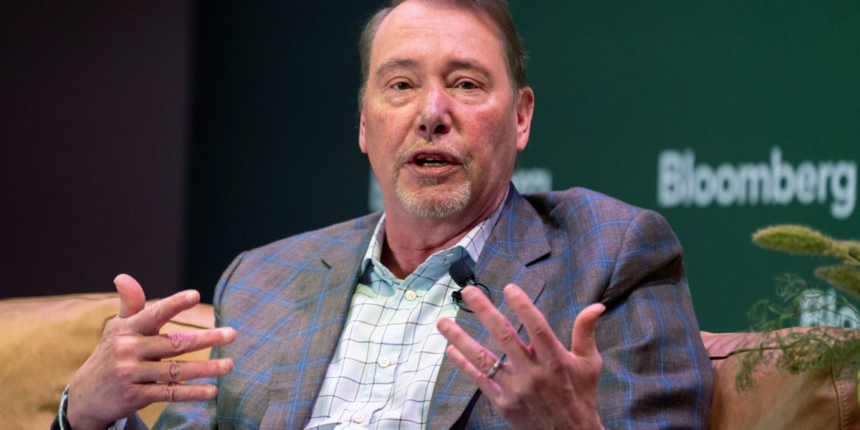
Gundlach explained that, in recent years, the “garbage lending” that plagued public markets before the Great Recession has shifted into private markets. Private credit has become increasingly popular and is now over-allocated to by large asset pools. The core problem, according to Gundlach, lies in the fundamental lack of transparency and liquidity.
Given these vulnerabilities, Gundlach recommended investors allocate less to financial assets than typical, suggesting a maximum of 40% in equities (largely non-U.S.) and 25% in fixed income (favoring short-term Treasuries and non-dollar fixed income). He advocated for the remainder to be held in cash and real assets like gold. Gundlach reminded investors that market trends, even when correctly identified, take time to unfold, citing his own experience where being negative on packaged mortgages in 2004 took three years to start decaying.
To be sure, Gundlach is plenty concerned about AI, noting that it’s similar to one of the biggest ever breakthroughs in technology roughly 100 years ago: electricity.
“Electricity being put into people’s homes was probably one of the biggest changes of all time,” he said, with the result that “electricity stocks ere in a huge mania” around 1900, and they performed very well. Unfortunately, this peaked in 1911.
“People love to look at the benefits of these transformative technologies,” but those benefits get priced in very early, during what Gundlach called “mania periods,” adding, “I just don’t think there’s any argument against the fact that we’re in a mania.” But Gundlach also argued that some impossible things are happening on the national debt.
The massive U.S. national debt and soaring interest expenses are creating a mathematical impossibility that requires radical government intervention potentially within the next five years, Gunldach told Odd Lots hosts Joe Weisenthal and Tracy Alloway. He recalled the beginning of big deficits in the Reagan years, when the national debt was considered a distant threat, but it used to be a 60-year problem, then a 40-year and a 20-year, but now it’s a five-year problem, which means it’s a “problem in real time.”
Gundlach said his conviction is based on the accelerating trajectory of U.S. government debt and interest costs. The official deficit stands at approximately 6% of GDP, a level historically associated with the depths of recessions. Currently, interest expense consumes about 30% of the $5 trillion in federal tax receipts. This figure is poised to climb higher as outstanding bonds, which have an average coupon of around 3% for the next few years, roll off and are replaced by new debt issued at higher rates (Treasuries are currently yielding up to 4.5%).
Drawing on plausible assumptions regarding deficit growth, Gundlach outlined a stark prognosis for the end of the decade. Under the current tax and borrowing regime, he said, it is “quite plausible” that by 2030, 60% of all tax receipts will be allocated to interest expense. Pushing the projections further under a pessimistic scenario (Treasury rates hitting 9% and the deficit reaching 12% of GDP), the situation becomes mathematically impossible: “by around 2030, you would have 120% of tax receipts going to interest expense, which of course is impossible.”
Gundlach argues something will have to give: “What happens is that you have to blow up the entire system, because all the tax receipts would go to interest expense.” This inevitability means the traditional rule system must be abandoned. When something is impossible like this, Gundlach added, “you have to open up your mind to a radical change in the rule system.”