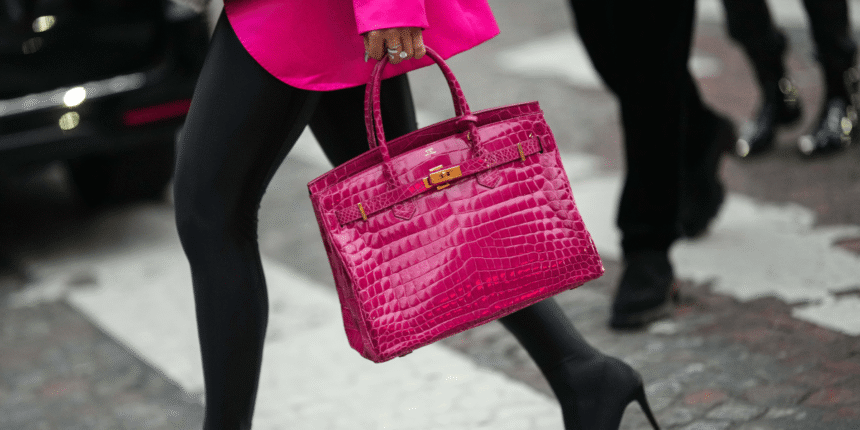
The value of a Birkin bag skyrockets from the moment it leaves the Hermès store.
That’s partly because not just any regular person can buy the bag. Only customers with a sizable purchase history at the brand are offered the opportunity to buy a “quota bag,” such as a Birkin or a Kelly.
Looking to sidestep the Hermès Game and score the bag their heart desires, handbag enthusiasts shell out tens of thousands of dollars on the resale market. Thanks to its exclusivity and its status as an investment piece, a Birkin bag’s value is much higher than its sticker price of around $12,000.
“I know several instances where people have doubled their money based on buying it 10 years ago, and reselling it today in pristine condition,” he said.
For some buyers, a Birkin bag isn’t a high-end piece of arm candy, but a worthy investment. Of the Birkin owners he has worked with, Firestein estimates 75% actually use the bags, while the remaining 25% keep them in storage as investments.
“It’s similar to buying a Piccaso and holding it in your home, because you can look at it, you can enjoy it,” Firestein said. “But then you ship it off in a couple of years and trade it for something else.”
The value of an Hermès bag can increase dramatically over time, Firestein said, depending on its color, material, and condition. Secondhand demand is so high partly because the resale market offers shoppers more options than the Hermès store, where customers are allowed one quota bag per year, and rarely get to choose the exact model they want.
Firestein said the steepest price increase he has seen was a Black Togo 30 Birkin that doubled in value in five years. But price increases can be driven by trend cycles and changing demand—so it can be a “gamble,” he said.
“I wouldn’t say jump in with both feet at this point,” he said. “But if you got it in 2012, and you sold in 2019, that’s different.”
Before its handbags were spotted on the arms of Jane Birkin and Cardi B, Paris-based Hermès began in 1837 as a maker of horse harnesses. Over the course of six generations, it became a ready-to-wear and leather-goods powerhouse renowned for its craftsmanship.
As for the iconic Birkin bag, here’s how the legend goes: In 1984, the late actress Jane Birkin was seated next to Jean-Louis Dumas, executive chairman of Hermès at the time, on a flight from Paris to London. Birkin said she couldn’t find a bag that suited her needs as a young mother—so she sketched her dream design on a sick bag, according to CNN. Dumas infused the bag with equestrian elements, giving it the signature Hermès look.
“It was more of a subtle old-money brand,” Firestein said of Hermès’ status prior to the Birkin craze.
The Birkin slowly reached “it bag” status thanks to being spotted on the arm of many celebrities in the 1990s and 2000s—and on Sex and the City. But it wasn’t until the 2010s, when the online resale market reached the masses, that the hype went stratospheric.
Firestein credits e-commerce with enabling shoppers to buy a secondhand Hermès bag from any part of the world. Meanwhile, online forums allowed people to share the secrets of the Hermès Game once exclusive to the 1%. The Birkin became a collector’s item over time—and underground demand continues to fuel the resale market.
Some people may desire Birkin bags because they’re so hard to get—but fans also celebrate the brand’s artisan manufacturing and 200-year legacy of craftsmanship.
“Their leather factories are only Hermès affiliates, and they only create Hermès leathers,” he said. “So you’re buying into part of that heritage, but then you’re also buying into a higher-quality material that they’ve been using for many, many years.”
Compared to other brands, Hermès’ quality is “top-tier,” Firestein said. And though he works with 43 different luxury brands, he admits to having an affinity for Hermès bags.
“They’re made to last for generations,” Firestein said. “And they’re just beautiful luxury objects at the end of the day—almost like sculptures.”
A version of this story published on Fortune.com on March 27, 2024.