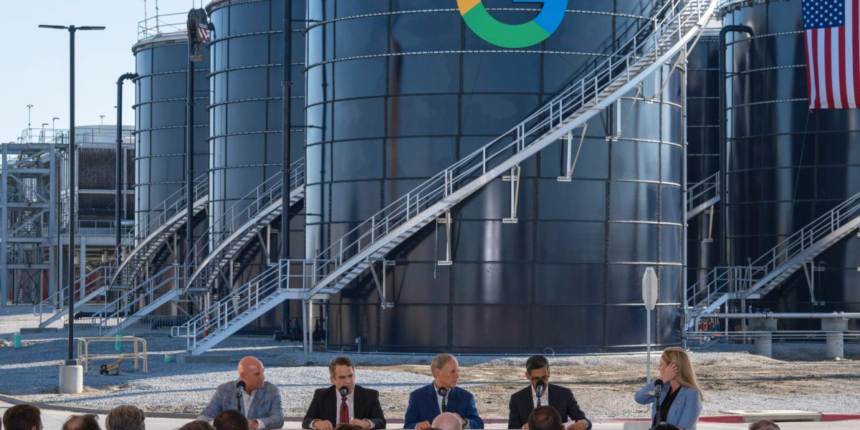
Big Tech AI spending has reached new heights.
And Big Tech is putting all of its eggs in one basket: Not only are the dollars dramatically higher, but the spend is more concentrated in a single purpose—scaling AI compute—rather than in a mix of strategic bets.
“We’ve never invested this much in anything before,” Gil Luria, managing director and head of technology research at financial services firm D.A. Davidson, told Fortune. “But we’ve also never had a technology this promising before.”
As firms invest in physical data center infrastructure, some experts say the next round of buildouts could reach your town. “I firmly believe that the ‘Stranger Things’ mall where they battle the creature will be converted to a data center,” Brent Thill, an analyst at investment banking firm Jefferies, told Fortune.
Thill said the buildout is addressing the AI industry’s existing bottleneck: physical infrastructure. He said the bottleneck has shifted from chips to energy, and now, it’s the physical shells that are lacking. “It went from a chip shortage, a GPU shortage,” Thill said. “Now, it’s a physical shell shortage.”
Still, investors in tech giants are growing nervous because these firms are essentially exhausting their available capital to fund the infrastructure buildout, according to Luria. He said shareholders want to see returns, not added investment. “‘We understand that you want to invest all this money, but you’re investing all our money, you’re taking all your cash and all your cash flow and investing it,’” Luria said of the shareholder mindset.
Despite the selloff, Big Tech is betting on high ROI from AI. “We’re in a game of leapfrog now,” Thill said. “You have three to four big public vendors that are all lined up for this prize.”
As to why the buildout is taking off, Thill said that, given today’s demand for AI data centers, the only concern among tech firms is the risk of not doing enough. Any overbuild would grant some payoff.
“Even if you overbuild,” Thill said, “there’s so many people that would buy that overbuild even if they couldn’t sell it to their clients. Other people would want to procure it: state, local governments, [and] federal governments.”