After a few years of sharing a 2019 Chevrolet Trax, Dana Eble and Tyler Marcus are finally looking for a second car. But as they jump into the market, the young married couple isn’t sure what they can afford.
“I just keep seeing a lot of different aspects of life getting more expensive, and it’s harder,” said Eble, an account manager for a public relations agency.
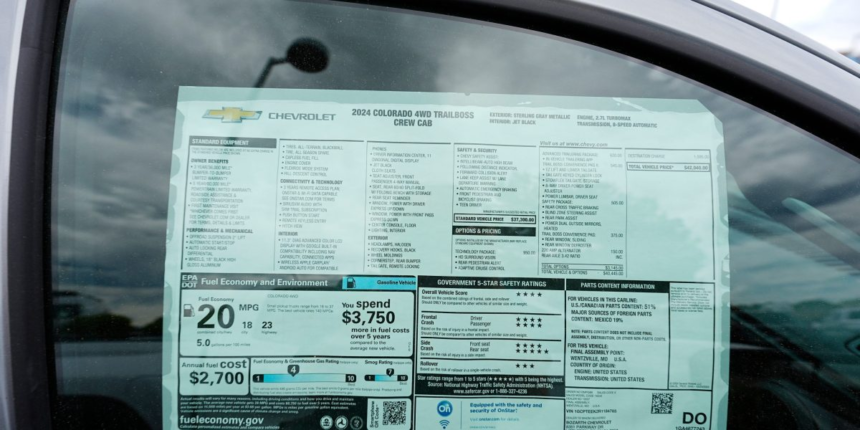
Car ownership has long been integral to the American dream. But as automakers slash the production of inexpensive models to cater to customers who can afford oversized pickups and sport utility vehicles, buyers find themselves facing sticker shock at the same time they are already frustrated by the lingering effects of high inflation.
New vehicles now sell for an average of nearly $50,000, up 30% in six years, and average monthly payments — based on 10% down and a 6-year note — recently hit $775. Looking for something on the cheap end? The share of vehicles listing for less than $30,000 is about 13% — down from 40% five years ago, per the car review site CarGurus.
To cope, buyers are spreading their payments out longer. Consumers choosing 7-year loans make up more than 12% of all sales, up from nearly 8% a year ago, according to auto buying resource J.D. Power. Such contracts wind up costing more in the long run because of interest payments.
“The ability to buy transportation is still out there. The question is just, what do you get for your money?” Charlie Chesbrough, a senior economist at Cox Automotive, said.
Sticker prices have been rising since automakers discovered Americans are willing to pay more for bigger, more expensive SUVs and pickup trucks that bring the companies more profit from each sale. They have largely phased out smaller, cheaper sedans.
Car companies are also savvy about placing desired options in more expensive trim levels that can lure consumers into a vehicle that costs more than they planned, said David Undercoffler, the head of consumer insights at CarGurus.
Advanced safety technology — lane-keep assist, automatic emergency braking, blind-spot monitoring, collision warnings and more — all add to the cost of a vehicle. Automakers are required by federal industry rules to add some features, such as rear-view cameras.
The share of new car buyers earning below $100,000 fell to 37% last year, down from 50% in 2020, according to Cox Automotive.
Chesbrough thinks consumers are sometimes unrealistic in their wants.
“There are vehicles out there for less than $30,000. What everybody wants is the mid-sized SUV with leather seats and the sunroof for $25,000, and that’s not available,” Chesbrough said.
Those buyers, he said, are being pushed into the used market.
But as those buyers shift to used, they are finding fewer affordable options there, too. The share of used vehicles priced less than $30,000 fell from 78% in 2021 to 69% in February, according to CarGurus. The average used vehicle sold for about $25,000 in February, and the average used monthly payments hit $560.
J.D. Power estimates that consumers might spend up to $140 less on a lease payment than the average finance commitment, a good option especially for drivers whose annual mileage is predictable. But experts say there is still an affordability challenge.
Sam Dykhuis, 27, of Chicago, needed to buy her first car recently when she started a new job as a scheduler for United Airlines. She searched for something used under $20,000, and eventually paid a little more than that for a 2021 Mazda CX-5. To hold down the cost, she tapped savings to buy the car outright. She pays insurance six months at a time to save a few bucks, too.
Still, “My paycheck went down and my expenses went up,” Dykhuis said. “Certainly, I have to be more just on top of it than I was previously.”
Eble, 30, and Marcus, 31, say they appreciate cool vehicles but don’t consider themselves “car people” and are hoping their search is easier as a result. Still, finding something in their $20,000 to $30,000 budget might not be as easy as it once was.
Like Dykhuis, they say they also might buy their new ride outright to avoid a new monthly payment.
“It feels like if anything happens out of our control … it just seems so much more difficult to figure out how to orient our finances,” Eble said.