When Dr. Brian Moraes opened his practice in Boca Raton, Fla., he was following in the footsteps of his physician parents and grandfather, a Bombay-based general practitioner. Moraes hoped to do what the vast majority of those in health care set out to: help patients.
But in 2025 he spends his days “putting out fires.”
Instead of meeting and treating as many patients as he can, his hours are often clogged with referrals to geriatric specialists, who are increasingly hard to find. So, too, are psychiatrists, with Moraes often providing the support himself, as well as endocrinologists who have expertise in hormonal imbalances associated with diabetes and osteoporosis, and rheumatologists who specialize in autoimmune conditions like arthritis.
Then, two or three times a week, he will have appointments with recurring patients: those he discharged on the basis of ongoing care at home, who then have no choice but to return to the outpatient center when care workers prove too hard to find, adding hours onto his already packed schedule.
With the workload and friction increasing, it’s perhaps no surprise to the nephrologist—whose focus is the study of kidneys and diseases related to blood pressure—that his peers are retiring earlier, inadvertently increasing the burden on those still in the field.
Much of Moraes’s difficulty stems from a shrinking pool of skilled labor in the health care workforce. While his practice hasn’t struggled to recruit talent, referrals for specialist care that he cannot provide are getting tougher. And the problem is likely to get worse: Much of the expertise he and his patients need is in geriatric care, a sector which few medical students want to pursue.
Trump’s immigration plans have already presented some unforeseen economic outcomes: Experts believe America’s unemployment rate has remained relatively stable because job losses are being offset by a shrinking labor force as individuals leave the U.S. The economy has withstood weak role creation precisely because the pool of applicants is shrinking.
On the other hand, a working paper from the American Enterprise Institute (AEI), a conservative economic policy center, found the Trump administration’s immigration policy—even before the changes to the H-1B visa were announced—will likely result in negative net migration in 2025, shrinking U.S. GDP by between 0.3% and 0.4% as a result.
While the Oval Office has made clear its intention to grow the American economy in other ways, the issue remains that the risks of lower immigration aren’t just about what foreign-born individuals are contributing, but also how they’re doing it.
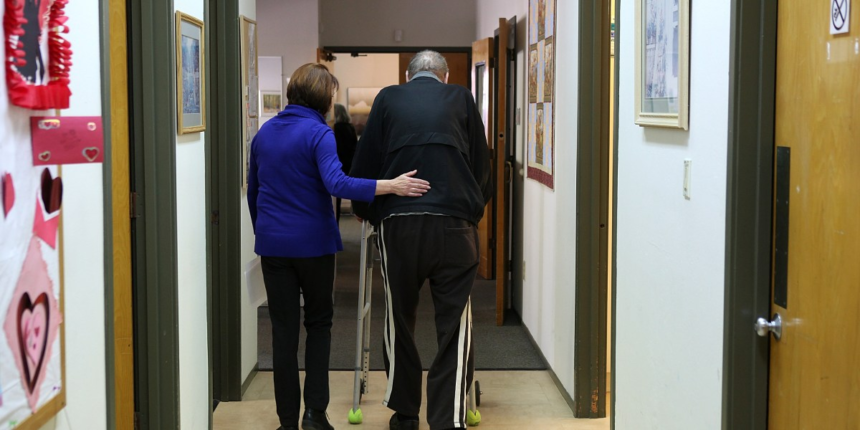
The health care sector also has an additional pressure to wrangle: how to care for an aging population when the domestic workforce isn’t doing it themselves.
“There’s a huge gap in geriatric care,” Moraes tells Fortune. “I don’t talk to any medical students who say, ‘Oh, I want to go into geriatrics when I get out.’ Everybody says, ‘I want to go to dermatology or orthopedics.’
“Our aging population is definitely increasing at a faster rate than our ability to take care of them. I don’t see that changing anytime in the near future. That’s one of the things that a lot of the international health care workers were able to fill: If you go to a nursing home or you go to a hospital on the night shift, it’s almost all international aides and nurses.”
He added: “When you’re talking about some of the other areas of medicine that are maybe not so lucrative like home health aides and and nurses and nursing aides, I have noticed that there is definitely a need for international people to be able to fill those positions because Americans just aren’t doing it, they’re not going into that.”
“President Trump will continue growing our economy, creating opportunity for American workers, and ensuring all sectors have the workforce they need to be successful.”
The cost of motivating talent into the medical workforce could pile further pressure on an already stretched sector, warned Moraes, adding that the U.S. may already be losing out on foreign-born talent because of changing goalposts on immigration policy. While he hasn’t encountered any individuals who have left the U.S. or are being blocked from coming as a result of changing policy, Moraes said he does see more “fear” and uncertainty.
“I think it’s going to be harder for people to trust the fact that they can come to this country and be able to stay and work here,” Moraes added. “Other countries are actually economically starting to do better, and it may be more lucrative. Once upon a time it was a very good lifestyle to come to the United States, but now there are so many other countries that people can choose from to go to, so I have a feeling that our workforce is going to start decreasing in the areas that Americans aren’t going to want to go into.”
The story is similar for New York urologist David Shusterman, a refugee who left the Soviet Union for the U.S. in the 1980s.
Shusterman’s concern is one of basic math: how to marry that rising reliance on foreign-born skilled labor with policies which are reducing net immigration. “Our medical schools are filled with foreign-born people, that’s really one of the issues. There’s a lot of positions that need filling right now; it’s hard to find a urologist, hard to find other specialties … We’ve been resorting to physician extenders—I have a lot of physician extenders in the office, but they’re also in short supply,” he tells Fortune. “Physician extenders” is an umbrella term for health care professionals who assist doctors to provide patient care, for example, nurse practitioners or physician assistants.
Immigration policy at present means “a lot of good people, because [of] the uncertainty, choose not to stay, or are more worried about staying,” said Shusterman. What’s needed is clarity, he said: “I know that at least 5% to 10% of the population of the urology programs are on visas, and those are people that if they want to stay here, they should be highly motivated to stay and not given the runaround treatment, because these are people who are in super-high demand. They would love to stay, mainly because of the reimbursement—they make more here than other places—and the reason they make more is because they’re needed.”
The expert advocated for the government—be it Trump 2.0 or thereafter—to lay out some clearer benchmarks on the skilled labor the U.S. wants to attract. While he believes the Trump administration is expediting some visas for skilled talent, he added: “My suggestion to the immigration department is to be much clearer about [saying], ‘This is what we need; if you study in these fields you have a clearer pathway. It’s something that is needed and in demand right now. And I stress that, that this is a highly productive group of individuals that is obviously going to work and make the country better, because they have skills that are marketable.
“It would help if even employers were able to advertise, like: ‘We have these qualified positions that the government will approve for you if you apply for this position,’” he added.
Based in Connecticut, reproductive endocrinologist Shaun Williams has yet to see his practice, Illume Fertility, impacted by shifting policy. While demand for his specialty is increasing as women are continuing to choose to have children later in life, Williams believes the industry is competitive enough to continue attracting and retaining talent.
Even looking at the health care industry more widely, he’s relatively unconcerned: “I don’t think there are any changes that happen over a four-year period that will cause any long-term effects to the health care industry here in the United States. It will work itself out. There will likely be exceptions for different things—if it’s difficult to get certain visas in certain areas—[but] none of these changes are permanent.”
Staffing costs and availability are chief among the reasons, the organization adds, both because skilled individuals can’t be sourced in rural areas and because the traditional long hours and on-call schedules poses further hurdles for recruitment. “Rural maternity care is in a state of crisis, and more women and babies in rural communities will die unnecessarily until the crisis is resolved,” the center adds.