That report laid out the increasingly high stakes the nation is facing from its overindulgent borrowing, including risks of crowded-out spending, the diminishment of the dollar’s status as a global reserve currency, and persistently high interest rates that will inhibit long-term economic growth. But as the report noted, the U.S. has been in similar messes before, and history offers a helpful blueprint for what the country could do to navigate the current crisis.
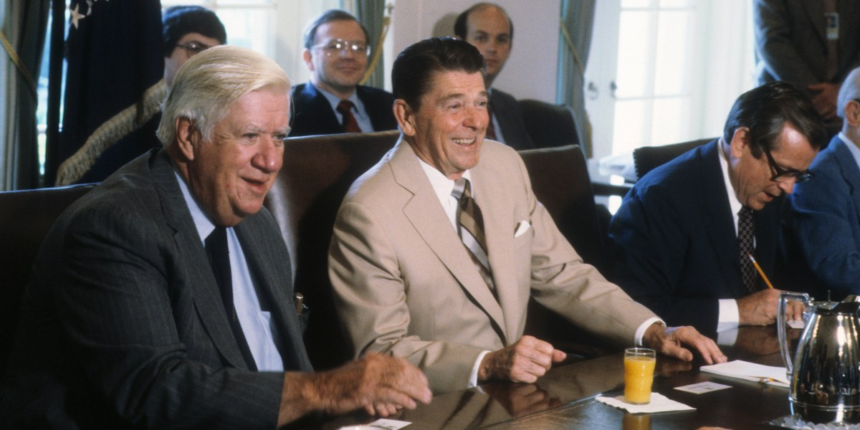
In 1981, to save the trust fund, President Ronald Reagan appointed a 15-member bipartisan body, known formally as the National Commission on Social Security Reform but remembered by history as the Greenspan Commission, named after its chair: future Federal Reserve boss Alan Greenspan. Composed of lawmakers, outside experts, and business leaders, the commission was tasked with finding a way to save the program from collapse.
Central to this success was a “private pact” between Reagan and Tip O’Neill, the Democrat house speaker at the time, in which both leaders agreed not to publicly oppose the commission’s recommendations. This agreement provided the necessary political cover for lawmakers to support difficult changes to revenue and benefits. Furthermore, an informal rule in the Senate dictated that any senator opposing a recommendation had to propose their own alternative solution, effectively separating the reforms from standard partisan debate. These 1983 amendments extended Social Security’s balance by decades and remain the last major reform of the program.
The CED report called for a modern iteration of such a bipartisan commission, calling it a “promising solution that could break the political impasse” once again. Such a commission would provide a venue for lawmakers to focus on long-term sustainability and take the “difficult votes necessary to reset our fiscal trajectory.” By including cochairs from both parties and requiring a bipartisan majority for approval, a commission could lend more credibility to essential reforms, the report argued.
“For a bipartisan fiscal commission to be successful, there must be sufficient political will, strong leadership, and a spirit of collaboration,” the report’s authors wrote. “Commissions provide structure for negotiations and legislative procedures for enactment, but by themselves, they cannot produce the political will for reform.”