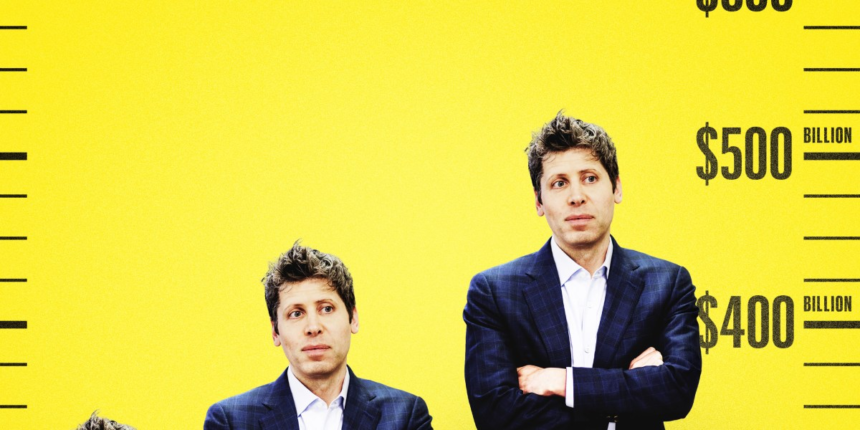
Everyone keeps asking: “Are we in an AI bubble?” But just as often, I hear a different question, followed by recognition: “Wait—they raised another round?”
This year, a handful of top AI startups—some now so large that calling them “startups” feels vaguely ironic—have raised not just one giant round of funding, but two or more. And with each round, the startups’ valuations are doubling, sometimes even tripling, to reach astonishing new heights.
Take Anthropic. In March it raised a $3.5 billion Series E at a $61.5 billion valuation. Just six months later, in September, it pulled in a $13 billion Series F round. New valuation: $183 billion.
In other words, in the 12 months between October 2024 and October 2025, OpenAI’s valuation increased by roughly $29 billion every month—almost $1 billion per day.
It’s not just the LLM giants. Further down (but still high on) the AI food chain, recruiting startup Mercor in February raised its $100 million Series B at a $2 billion valuation—and then by October raised another $350 million as the company’s valuation leapt to $10 billion.
These valuation growth spurts, especially at a scale of billions and tens of billions of dollars, are extraordinary and raise a number of dizzying questions, beginning with: Why is this even happening? Is the phenomenon a reflection of the strength of these startups, or the unique business opportunity presented by the AI revolution, or a bit of both? And how healthy is this kind of thing—what risks are the startups, and the broader market, taking on by raising so much capital so fast and pumping valuations up so quickly?
Tom Biegala, founding partner at Bison Ventures, said that he doesn’t believe this is anything like 2021, when “companies would raise a round… not because they’ve made any sort of real progress or any technical or commercial milestones.” Investor enthusiasm was so high and capital flowed so effortlessly back then that the perception of momentum was often enough to draw more than one round of capital in a year, Biegala said.
Terrence Rohan, managing director at Otherwise Fund, says today’s multi-round startups are demonstrating real business traction: “The revenue growth we’re seeing in select companies is without precedent. In certain cases, one could argue that we are dealing with a new phenotype of startup,” Rohan said via email.
Felicis Ventures founder and managing partner Aydin Senkut describes the back-to-back fundings as a sign of a high velocity market where the costs of being wrong are higher than ever. “The prize now goes to those who identify and support these outliers earliest,” Senkut says, “because being in the wrong sector or too late may not just reduce returns, it may zero them out.”
While broad excitement over generative AI is fueling the series of funding rounds, startups pushing the boundaries in certain verticals are among the biggest beneficiaries of the trend.
Harvey, an AI startup aimed at the legal industry, raised a total of $600 million in two separate funding rounds within the first six months of 2025, lifting its valuation first to $3 billion and then to $5 billion. In October, several outlets, including Bloomberg and Forbes, reported that Harvey just raised another round of funding that gives the startup an $8 billion valuation.
Each is representative of their respective sectors: Both coding and legal AI are booming right now. Legal AI company Norm AI in November raised $50 million from Blackstone—shortly after raising a $48 million Series B raised in March. Likewise, in coding, Lovable raised its $15 million seed round in February, followed up with a $200 million Series A at a $1.8 billion valuation by July.
Healthcare and AI is also hot, with companies like OpenEvidence raising its July Series B of $210 million at $2.5 billion valuation, only to follow up in October with another $200 million at a $6 billion valuation. Abridge (last valued at $5.3 billion) and Hippocratic AI (last valued at $3.5 billion) fall into this category, as well.
Max Altman, Saga Ventures cofounder and managing partner, says the trend isn’t simply the result of exuberant startup investors throwing money around. For some startups, rapid-fire fundraising is becoming part of the strategic playbook—an effective means of taking on competition.
That said, that doesn’t mean everyone attracting massive capital is a winner waiting in the wings.
If raising multiple rounds quickly can be a strategic advantage, it can also become a dangerous liability. Or, as Andreessen Horowitz general partner Jennifer Li puts it, these back-to-back fundraisings can go right—and they can go wrong.
“They go right when the capital directly fuels product market fit and execution,” Li said via email. “For example, when the company uses new resources to expand infrastructure, improve models, or meet outsized demand.”
So when do they go wrong?
“When the focus shifts from building to fundraising before the foundation is set,” said Li.
Like a skyscraper built on unstable ground, startups that can’t support overly lofty valuations risk a painful comedown. The valuations of some of hyped AI startups may look untenable (perhaps even unhinged) in the public markets, should the startup make it that far. The resulting recalibration manifests itself in the plummeting value of employees’ equity, creating talent retention and recruiting risks. Many of 2025’s biggest IPOs, such as Chime and Klarna, were decisive valuation cuts from their 2021 highs.
Within the private markets, rapid rounds of fund raising means cap tables can get quickly complex as founder stakes dilute. And then perhaps, the biggest risk of all: That some of these excessively funded startups end up with wild burn rates that they can’t roll back if times get tough and capital dries up. That can lead to layoffs, or worse.
Ben Braverman, Altman’s Saga cofounder and managing partner, said this is ultimately a story about both the concentration of capital in AI and about how VCs have evolved their strategies in the aftermath of 2021. Venture capital has always been about the Power Law—that big winners keep winning big—but that’s become especially true as VCs chase consensus favorites more than ever.
“The story of 2021 to now, on all sides of the market, is a flight to quality,” said Braverman. “Seemingly VCs made the same decision over the last cycle: ‘We’re going to put the majority of our dollars into a few brand names we really trust. And obviously, that has its own consequences.”
One of those consequences is that more capital than ever is flowing into a limited set of AI darlings. And while term sheets are being signed at a feverish pace today, even bullish investors acknowledge that, like any cycle, there will be winners and losers.
“In this type of environment, investors sometimes fall into a trap where they think every new AI model company is going to look like OpenAI or Anthropic,” Bison Ventures’s Biegala told Fortune.
“They’re assigning big valuations to those businesses, and it’s an option value on those companies becoming the next OpenAI or Anthropic,” Biegala said. But, he notes, “a lot of them are not necessarily going to grow into those valuations…and you’re going to see some losses for sure.”