It’s an early signal of a broader shift: while AI won’t determine every race in the upcoming midterms, it is emerging as a potent new pressure point in American politics, particularly as deep-pocketed Silicon Valley interests begin injecting themselves into local contests from afar.
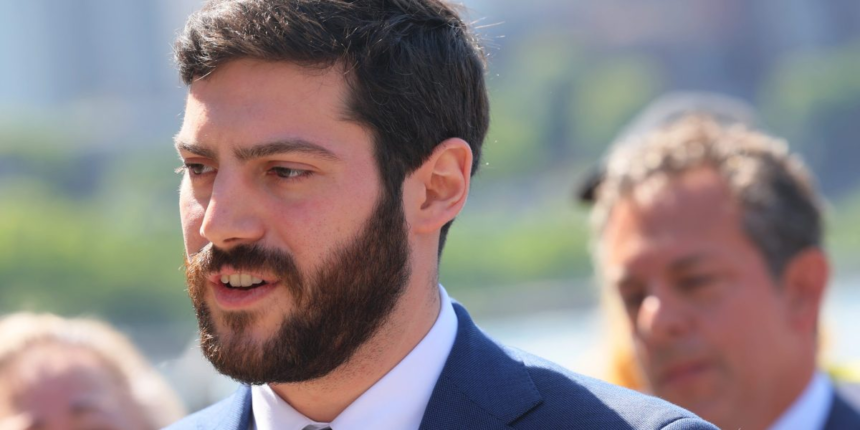
Bores is the chief sponsor of New York’s RAISE Act, which would require large AI labs to create and follow safety plans designed to prevent critical harms; disclose serious safety incidents, such as the theft of an AI model; and avoid releasing systems that pose “unreasonable” risks. Companies that fail to comply could face civil penalties of up to $30 million. The legislation—similar to a California’s SB-1047, a bill vetoed by California Governor Gavin Newsom last year—awaits Governor Kathy Hochul’s signature and has attracted support from AI safety advocates, policy groups, and prominent researchers including AI “godfathers” Yoshua Bengio and Geoffrey Hinton.
But many AI researchers, engineers, founders, and major tech investors see both the California bill and the RAISE Act as imposing vague, overly burdensome requirements that could be unworkable in practice —especially for startups.
Josh Vlasto, co-head of Leading the Future and a spokesperson for Fairshake, the $141 million crypto-aligned super PAC, told me that Bores “has championed a piece of legislation that would contribute to a national patchwork that is not workable and has not engaged productively with the industry.”
Bores, for his part, is leaning into the role of combatant after learning he would be the PAC’s first target. “It doesn’t surprise me,” he said. “They said they were going to target four states — California, Ohio, Illinois and New York — so I kind of figured who they were thinking about in New York.”
He dismissed opposition to the RAISE Act as “an extremely loud minority that has decided to yell over the broad majority support by spending hundreds of millions of dollars,” because they don’t believe there should be regulation on AI, though he stressed the bill is not a partisan flashpoint. “The RAISE Act passed in New York with every single Republican state senator voting for it, and a majority of the Republican state assembly members voting for it, including a number who co-sponsored it,” he said. “Republicans like Sarah Lightner in Michigan have introduced similar bills, and we conducted a poll that found 84% of New Yorkers supported the bill. There is strong bipartisan support for lightweight, reasonable regulations to keep people safe.”
Leading the Future, however, rejects the idea that it is opposed to regulation. “It’s not true that Leading the Future is anti-regulation,” Vlasto said. “The idea [that] we are trying to stop Congress from acting is just wrong, and we have been clear about it since our launch in August.”
He argued that AI safety advocates have long enjoyed a structural advantage. “The other side has spent billions over the past decade investing in political organizations and think tanks,” he added. He pointed to groups like Open Philanthropy, a grant-making organization funded largely by Facebook co-founder Dustin Moskovitz and his wife, Cari Tuna. It grew out of the Effective Altruism (EA) movement, whose donors focus on areas they view as high-impact but under-resourced — including global health, biosecurity, and long-term or “existential” risks from advanced AI.
Vlasto would not comment on whether Leading the Future will be targeting Democratic California State Senator Scott Wiener, who co-sponsored California’s SB-1047 bill and is now running to fill Nancy Pelosi’s vacant Congressional seat. But with Silicon Valley money flowing in and rising debates over AI regulation, it’s clear this first strike won’t be the last.
With that, here’s more AI news.