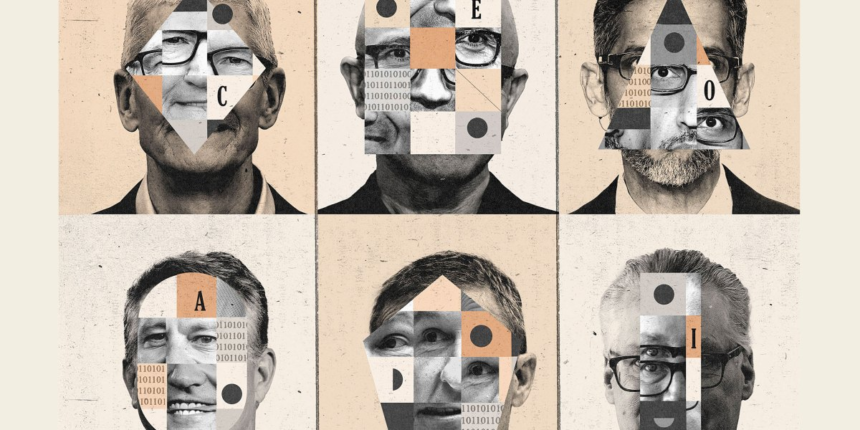
“What we are seeing across the board is a desire for CEOs who bring more of a beginner’s mind and adaptability.”
“Between the compression of the disruption cycle and the risk that’s inherent, boards’ expectations for CEOs are that you’ve got to be an AI native,” says Chad Hesters, CEO of executive search firm Boyden. “You’ve got to understand this stuff, and you’ve got to understand it is not a gradual shift.”
It’s certainly not coincidental that longevity and AI success have gone hand in hand in Big Tech. Nadella, who comes from a product background, is blazing a trail and showing other longtime CEOs how to acknowledge and approach the rise of AI: Microsoft’s early investment in OpenAI, and its integration of ChatGPT with its Azure Cloud business, are hallmarks of his tenure.
The rise of AI has coincided with shrinking CEO tenures, as leaders race to adapt.
7.2 years
15.8 years
306
Though elder statesmen by the relatively youthful standards of tech, Nadella and Pichai have figured out how to navigate a technology that is changing how business operates. It’s not about pure AI skills a computer scientist might possess, but rather about AI savvy and understanding how AI can help them, and the companies they lead, to compete.
After all, a tech CEO’s job is almost never focused on coding and the technical minutiae of AI, or of any other tech for that matter, but instead on taking the big-picture view and designing and implementing strategy. The job also calls for the perspective that comes with experience, the better to understand the nuances in the changes that AI may bring about in other elements of a business, such as data privacy and security.
Still, the urgency of CEOs needing AI-oriented sensibilities is hardly limited to tech companies. Indeed, every industry stands to be transformed by AI. In retail, AI will radically change business pillars like customer surveys and inventory management, while airlines will use it for such crucial tasks as optimal rescheduling of flights in case of a dramatic snowstorm, or predicting airplane component failures.
Companies certainly believe that investors care: A FactSet report in December found that during the most recent quarterly earnings season, the term “AI” was cited on 306 earnings calls conducted by S&P 500 companies, well above the five-year average of 136.
That said, older tech and legacy industry CEOs don’t necessarily need to fret if they lack the time or the aptitude to become AI insiders. They can survive, and even thrive, in the AI wave provided they show intellectual curiosity and adaptability, says Jason Baumgarten, partner at leadership advisory firm Spencer Stuart, who helps train CEOs and advises boards.
“What we are seeing across the board is a desire for CEOs who bring more of a beginner’s mind and adaptability, and not a rigorous pushback to ‘how it used to be,’” Baumgarten says.
More than ever, CEOs need to be thinking ahead to what their industry and their clients’ needs will look like in the very long term. “You can’t just ‘CEO’ your way through this and just delegate this,” says Fawad Bajwa, global AI, analytics, and data practice lead for Russell Reynolds. “You need to take charge of what this means, in terms of the possibilities and constraints and the potential risks.”
In an echo of the froth of the 1990s, when people understood the internet would dramatically change life but didn’t quite know how or how quickly, near-term anticipation has possibly outstripped the reality of what AI will ultimately deliver. Certainly the stock market has been bumpy lately, as investors try to figure out whether companies are spending too much on AI in the short run.
So CEOs will have to guard against getting carried away by the hype, and avoid making bets on initiatives whose utility isn’t relatively clear. “You’re going to be held accountable for delivering an ROI,” says Boyden’s Hesters.
It’s not only Fortune 500 CEOs who will have to show ease and dexterity in the face of the AI revolution. Jeff Clavier, cofounder and board member of venture capital firm Uncork Capital, says he asks the CEOs of his portfolio startups to imagine what the fully AI-enabled version of their company and industry would look like—because, he tells them, for each of their companies there are another 10 startups that are gearing up for AI.
“The key characteristic for CEOs in an AI world is the ability to accept that fundamental changes will happen way, way faster than typical innovation curves,” Clavier says. He points to how ChatGPT, at just over three years of age, has changed so much. Every leader will have to accept the possibility that they may have to completely reinvent their business, in short order and regularly, in the AI era—in other words, to channel their inner Satya Nadella.
This article appears in the February/March 2026 issue of Fortune with the headline “AI is changing the CEO’s role—and could lead to a changing of the guard.”