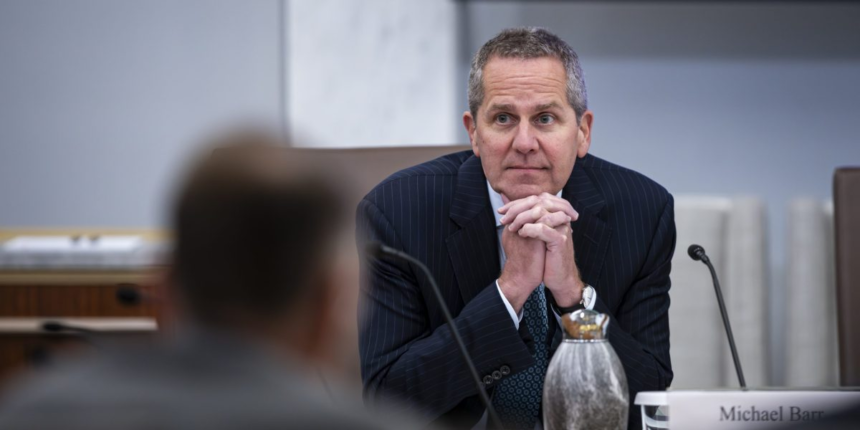
Federal Reserve Governor Michael S. Barr issued a stark warning on Tuesday regarding the potential trajectory of artificial intelligence, outlining a scenario where rapid technological advancement will create a “jobless boom” that leaves a significant portion of the population “essentially unemployable”.
He laid out three scenarios for how AI will impact the labor market, noting that predictions range from “the utopian to the apocalyptic”. The pace of technological change—and the resulting debate—is evolving quickly, though.
In detailing what he termed a “scenario of rapid growth,” Barr described a future where AI agents replace a wide range of professional and service occupations, while robotics automate manufacturing and transportation. In this version of the economy, labor demand would concentrate in a few highly skilled trades or roles requiring human interaction, while capital holders and “AI superstars” capture the lion’s share of economic growth.
“Layoffs soar, leading to widespread unemployment in the short run and declines in labor force participation over time, as a large share of the population is essentially unemployable,” Barr said. He added that such a future would require, among other things, a complete rethinking of workforce development and the social safety net to prevent gains from being concentrated among a small elite.
Given these conditions, Barr signaled that the Federal Reserve is unlikely to lower interest rates soon. He explained that if AI drives a productivity boom, it would increase demand for capital and investment, putting upward pressure on the “neutral” interest rate. Additionally, the massive infrastructure build-out required for AI—including data centers and energy grids—could prove inflationary in the short term.
Barr also outlined a third “stalled growth” scenario, where energy shortages or a lack of training data cause the AI boom to bust, leading to financial stress comparable to the dot-com crash or the railroad panic of the 19th century.
Regardless of which scenario plays out, Barr concluded that the private and public sectors are currently ill-equipped to handle the potential speed of the transition. He warned that the “historical record on meaningful efforts to help workers in such a transition is not encouraging”.
“Society will need to be nimble and bold to reduce the pain of short-term dislocations,” Barr said. “Widespread AI adoption will very likely lead to dramatic and sometimes difficult changes in the way many of us work and live”.