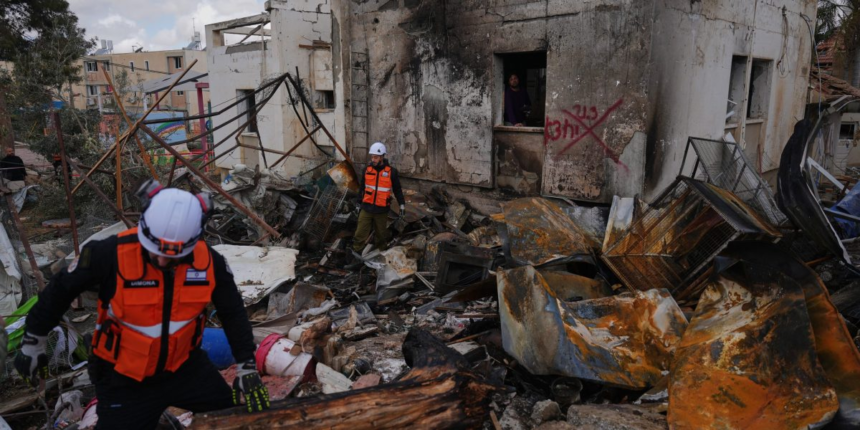
As Israel came under renewed fire, top Israeli leaders traveled to the southern town of Arad, one of two communities near a secretive nuclear research site struck by Iranian missiles late Saturday, wounding scores of people.
The developments signaled the Iran war, which the U.S. and Israel launched Feb. 28, was moving in a dangerous new direction, despite Trump’s mention last week he was considering “winding down” operations. It has killed hundreds of people, rattled the global economy and sent oil prices surging.
Hezbollah claimed responsibility for an airstrike Sunday that killed a man in northern Israel while Gulf Arab states — including Saudi Arabia and the United Arab Emirates — said they were intercepting fresh barrages of new Iranian strikes.
The blockade is a liability for both the U.S. and its allies in Europe and Asia, who rely heavily on the Persian Gulf supply to meet energy demand and power factories, vehicles and homes. The U.S. lifted some sanctions on Iranian oil at sea to relieve pressure on energy prices.
Trump said if Iran didn’t open the strait, the U.S. would destroy its “various POWER PLANTS, STARTING WITH THE BIGGEST ONE FIRST!”
Separately, Iranian officials said they would keep providing safe passage through the strait to vessels from countries other than its enemies.
Tehran praised the attack as show of strength, even as Israel’s military asserts that Iranian missile launches have gradually decreased in frequency since the war began.
“If the Israeli regime is unable to intercept missiles in the heavily protected Dimona area, it is, operationally, a sign of entering a new phase of the battle,” said Qalibaf, the Iranian parliament speaker.
Dimona is about 20 kilometers (12 miles) west of the nuclear research center, and Arad about 35 kilometers (22 miles) to the north.
Soroka Medical Center, southern Israel’s main hospital, received at least 175 wounded from Arad and Dimona, the hospital’s deputy director Roy Kessous told The Associated Press.
The U.N. watchdog — the International Atomic Energy Agency — has said the bulk of Iran’s estimated 972 pounds (441 kilograms) of enriched uranium is elsewhere, beneath the rubble at its Isfahan facility.
Iran said that, in addition to Natanz, strikes also hit a hospital in Andimeshk. The Health Ministry reported patients and doctors were evacuated to another city.
Iran’s death toll in the war surpassed 1,500 on Saturday, state media reported, citing the ministry. In Israel, 15 people have been killed by Iranian strikes. More than a dozen civilians in the occupied West Bank and Gulf Arab states have been killed in strikes.
The war has also seen noncombat-related accidents, including a U.S. refueling plane crash in Iraq that killed six U.S. service members and a Qatari military helicopter crash on Saturday blamed on a technical malfunction. All seven aboard were killed, Qatari authorities said Sunday.
The Israeli civilian was killed in the northern town of Misgav Am in what Israel’s military said “seemed to be” a rocket attack. Israeli medics said they found the man in his car and released a video showing two vehicles ablaze.
Fighting in southern Lebanese towns have intensified recently as Israel continues its ground operations. Israel on Sunday expanded its list of targets to include all bridges over the Litani River, which Defense Minister Israel Katz said Hezbollah is using to move fighters and weapons into southern Lebanon. It later struck the Qasmiyeh bridge near Tyre.
Katz also ordered the military to accelerate its destruction of Lebanese homes near Israel’s northern border as part of a strategy he described as aligned with Israel’s campaign against Hamas in Gaza.
After Hezbollah fired rockets into Israel on March 2, the Israeli military launched an offensive that Lebanese authorities say killed over 1,000 people and displaced over 1 million. Hezbollah has fired hundreds of rockets into Israel.
Israeli military spokesperson Avichay Adraee issued a warning an hour before the Qasmiyeh bridge near the coastal city of Tyre was struck.
Lebanese authorities say Israel’s strikes have killed more than 1,000 people and displaced more than 1 million.