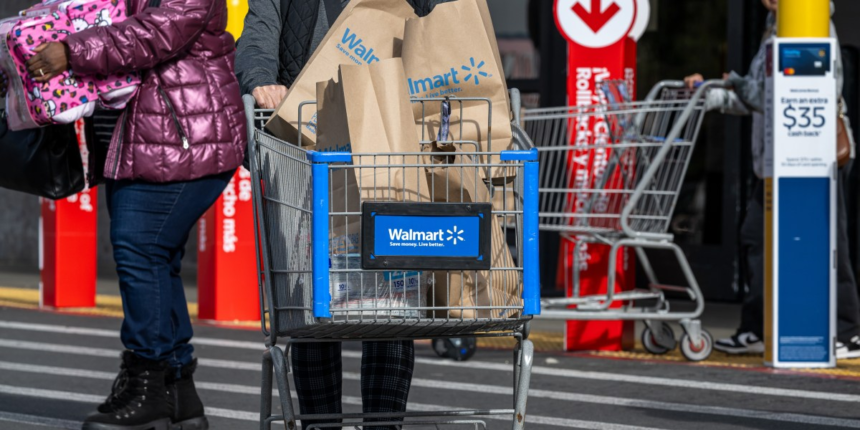
Paulsen, former chief investment strategist at investment research firm the Leuthold Group, devised an indicator he dubs the “Walmart Recession Signal” (WRS), which tracks the stock price of Walmart against the S&P Global Luxury Index, a basket of 80 companies producing or distributing luxury goods. He said that since economic downturns are usually felt first by lower-income individuals, an increase in Walmart’s stock price could indicate a potential economic downturn.
The central premise of the WRS is this: During economic downturns, consumers tend to shift their spending toward discount vendors like Walmart, and away from luxury retailers. It’s one way households cut down on costs when economic pressure is high. “As economic activity slows and recession risk builds, retailing purchasing patterns tend to gravitate toward discounters like Walmart and away from luxury retailers,” he wrote.
Walmart’s stock has climbed steadily over the past year, up over 40% year over year to $123.95 as of Tuesday afternoon. While the S&P Global Luxury Index is up over 7.7% year over year to $5,544.98, the price has fallen 13.6% since the beginning of the year.
“I’m concerned recession risks are uncomfortably high and on the rise,” said Mark Zandi, chief economist at Moody’s Analytics. “Recession is a real threat here.”
Paulsen said the WRS has had a close historical relationship with both annual real GDP growth and the unemployment rate. During successive economic downturns throughout the ’90s and 21st century, the WRS rose before real GDP growth collapsed. He adds that every increase in unemployment has been preceded by an uptick in the WRS.
As for the causes of what’s impacting the WRS, Paulsen cites cratering consumer sentiment, dismal job postings, the impact of the Iran war, among other factors. He also warns that instead of a public credit crisis, the economy may be facing a private credit crisis, as the WRS also has a close historical relationship with the value of private credit.
Yet Paulsen isn’t betting on a recession happening just yet, saying the U.S. may be in the clear this year.
But he adds, “I am becoming more convinced that a significant U.S. economic slowdown is unfolding that will ultimately require additional economic policy accommodation and lower interest rates to arrest.”