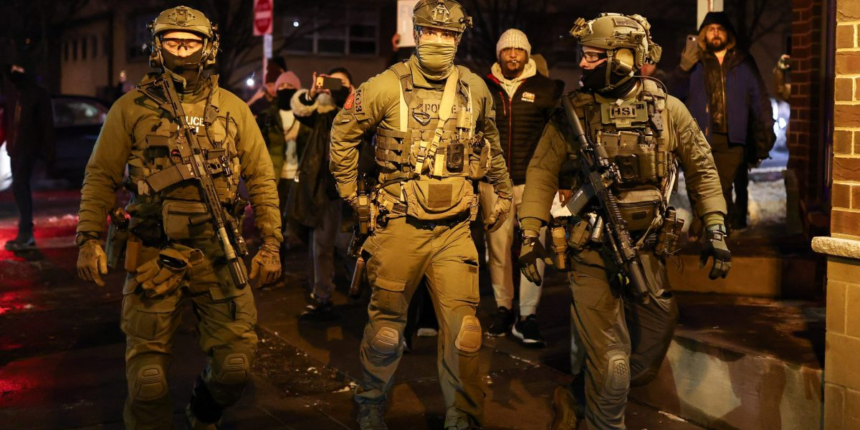
If President Donald Trump’s immigration crackdown in Minnesota was like a military campaign, then a new report from the Minneapolis Fed reads like a battle-damage assessment.
Like a war, the surge of federal agents to Minneapolis came with a name: Operation Metro Surge. It started in early December, but tensions in the city exploded a month later, when immigration officers killed two people, Renee Good and Alex Pretti, while observers captured videos of young children and elderly people being detained.
The Minneapolis Fed’s report described conditions in a staid manner, noting flat overall economic activity in its district. While prices, wages, and consumer spending were rising, the area’s agricultural, manufacturing, and real estate sectors were weak.
But details shared with the Minneapolis Fed by businesses it surveyed revealed how much damage Trump’s immigration crackdown inflicted. One contact from a landscaping firm said it had caused workers to either stay home or leave the area.
“We are hiring now to replace these workers or get more reliable alternatives, but there are not any people to hire,” the person told the Minneapolis Fed.
The report added that a “great number” of immigrant workers in Minnesota were unable to work as a result of the enforcement activity, with lost wages threatening their ability to pay for rent, utilities, and other necessities.
The absence of immigrants was so severe that a workforce development organization that offers English classes to new arrivals saw a 43% plunge in enrollment.
Because ICE and Border Patrol agents were rounding up U.S. citizens and immigrants here legally, the effects of their sweeps created a broad environment of fear.
“Hospitality and tourism firms, among others, said that legal, foreign-born workers were choosing not to work due to safety concerns, which were impacting operations as well as overall customer demand,” the Minneapolis Fed said.
In addition, enforcement activity impacted a builder as well as customers for a consultancy, which predicted “a lagging negative effect in a month or two,” according to the report.
Several contacts among minority- and women-owned businesses said employees, vendors, and customers alike “were afraid to travel” owing to all the federal agents.
Foot traffic was down sharply, particularly among retail and food services businesses, with many having trouble meeting financial responsibilities, the Beige Book added. In fact, several contacts from financial institutions saw a significant increase in requests for loan modifications.
Eventually, the backlash against Operation Metro Surge widened, with some Republicans calling for a reassessment of Trump’s tactics.
In late January, the president put border czar Tom Homan in charge of the crackdown, effectively demoting the Border Patrol’s Greg Bovino. And in mid-February, Homan announced the end of Operation Metro Surge, starting a gradual drawdown of federal agents.