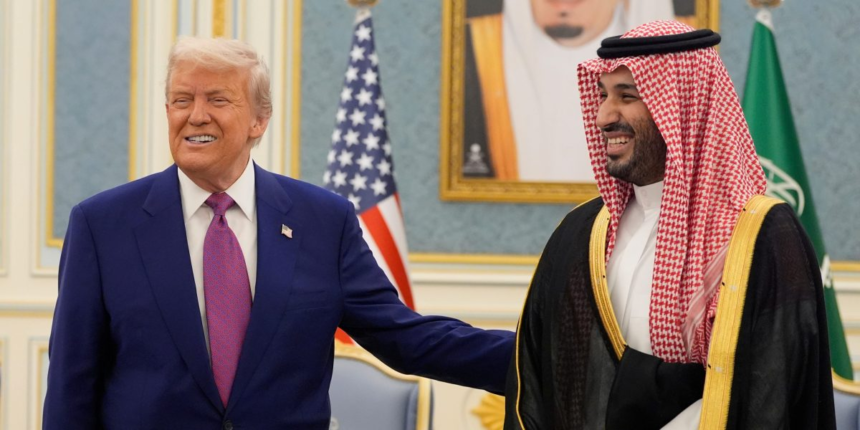
“I hope that Saudi Arabia will be going into the Abraham Accords very shortly,” Trump told reporters aboard Air Force One on Friday as he made his way to Florida for the weekend.
Yet Trump’s optimism that a U.S.-brokered deal could come soon is tempered by more sober internal assessments. Saudi Arabia is unlikely to sign on to the accords anytime soon, but there is cautious optimism that an agreement can be sealed by the end of Trump’s second term, according to three administration officials who spoke on the condition of anonymity to discuss internal deliberations.
Although the crown prince, widely referred to as MBS, has indicated he may be more flexible than his father on the matter, a guaranteed path to a Palestinian state remains a condition and something that Israel vehemently opposes.
One of the officials said the best outcome for this week’s talks, from the U.S. standpoint, might be for the Saudis to acknowledge Trump’s plan as the starting point for eventual Palestinian statehood and publicly agree to consider joining the accords.
Trump in recent weeks has predicted that once Saudi Arabia signs on to the accords, “everybody” in the Arab world “goes in.” He has asserted that the Saudis will join, given that the Gaza ceasefire is holding.
Trump says his optimism is informed by what he sees as a seismic shift in Middle East dynamics that he believes has created an opening for regional leaders to pursue lasting peace.
Nevertheless, Trump’s public confidence remains difficult to square with the Saudi position that any normalization deal requires first establishing a clear path for Palestinian statehood.
Yet the visit could present an opportunity for Trump to ease the crown prince toward his ultimate goal, particularly if Trump can show he is receptive to the need to establish a Palestinian state.
“Trump showing openness and even support for a Palestinian state could go a long way in his hopes of inching MBS toward normalization,” said John Hannah, who served as national security adviser for Vice President Dick Cheney.
But Trump certainly contends with some headwinds in persuading Prince Mohammed to get onboard, at least in the near term.
The searing images of the Israel-Hamas war remain fresh and rebuilding the ravaged territory will be a yearslong effort.
Israel and Hamas are making slow progress on the return of remains of the last hostages in Gaza. But several critical decision points on the horizon — disarming Hamas, establishing international security forces in the territory and establishing an alternative governance structure for a post-Hamas Gaza — could undermine the delicate truce if things go sideways.
“As long as the scenes on Saudi television continue to be scenes of devastation and misery in Gaza, I think it’s going to be very hard for MBS to move in this direction,” said Jonathan Schanzer, executive director at the Foundation for Defense of Democracies, a hawkish Washington think tank. “That said, I also believe that there are things that the Saudis can do, as they’ve done in the past, to advance the process of normalization across the region.”
The crown prince is expected to come to the White House with a wish list that includes receiving formal assurances from Trump defining the scope of the U.S. military protection for the kingdom and an agreement to buy U.S.-made F-35 fighter jets, one of the world’s most advanced aircraft.
But as the White House was wrapping up preparations for the visit, it appeared unlikely that Trump was ready to sign off on a deal for the fighter jets, the administration officials said. But they noted that Trump has a track record for unpredictability and could decide to approve the sales if the crown prince somehow persuades him.
The officials said the administration remains wary about upsetting Israel’s “qualitative military advantage” over its neighbors, especially at a time when Trump is depending on Israeli support for the success of his Gaza peace plan.
Another long-standing concern, which also derailed a potential similar sale to the United Arab Emirates, is that the F-35 technology could be stolen by or somehow transferred to China, which has close ties to both the UAE and Saudi Arabia.
The crown prince’s price for normalization has only risen in the aftermath of Gaza, said Hannah, the former Cheney aide, who is now a senior fellow at the Jewish Institute for National Security of America. But Hannah said it would be unwise for Trump to give up his leverage.
“I think it would be folly not to insist that the ultimate integration of these planes into the Saudi order of battle be tied to normalization and a more fundamental and permanent transformation in Saudi-Israel relations and the regional security landscape,” Hannah said.