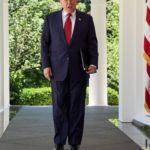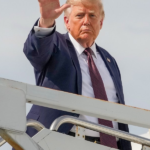
The project has been on his mind lately. During an hour-plus speech Monday to small-business owners, Trump spent about nine minutes talking about the paint job, detailing the granite floor and boasting that he whittled the renovation’s cost to $1.9 million from what he said was an initial $350 million estimate.
Trump’s next project might be East Potomac Park, home to an affordable, accessible public golf course with views of the Washington Monument.
And that was just this week in Washington’s extreme makeover.
Trump is guaranteeing himself a lasting imprint on a city where he won just 6.5% of the vote in 2024. He is flexing extraordinary executive power and offering fresh insight into how he spends his time, perhaps a president’s most valuable asset.
“It’s not a zero-sum game but obviously all presidents have limited amounts of capital they can use and limited amounts of attention that they have to give,” said presidential historian Julian Zelizer of Princeton University. “And he’s deciding, in a moment of war, a moment of economic instability, that this is a priority.”
Trump rejects such concerns.
For Republicans defending slim congressional majorities, it is not so simple. Many would prefer to talk about policy accomplishments, including tax cuts, rather than multimillion-dollar Washington construction projects.
While few directly criticize Trump, there is an acknowledgment that the party needs to confront economic realities.
A Washington Post-ABC News-Ipsos poll conducted in late April found that 52% percent of Americans oppose Trump’s planned arch. That includes about 6 in 10 independents. Some 51% of Republicans favor it.
Americans oppose the ballroom by a 2-to-1 margin, driven largely by Democrats and independents. About 2 in 10 Republicans oppose the project, according to the poll. The poll did not find a notable shift in support of the ballroom after a shooting at last month’s White House Correspondents’ Association Dinner. Trump has cited that incident in his push for a secure facility, something he did not mention when he initially ordered the demolition of the East Wing.
In a city where historic preservation is often sacred, the pace of change has been dizzying.
Rebecca Miller, the executive director of DC Preservation League, has spent 23 years at the organization, which sued to stop the golf course takeover and joined a coalition attempting to force the Kennedy Center to comply with preservation laws. She said her organization has worked with administrations of both parties and called the Trump moves “highly unusual.”
“One of the problems that we have right now is an administration that seems to think that it can just plow ahead without any input,” she said. “These assets are owned by the people of the United States. They’re not anybody’s personal portfolio.”
White House spokeswoman Taylor Rogers said Trump is “laser-focused on lowering costs for working families, deporting illegal criminals, keeping our cities safe, beautifying our nation’s capital, and protecting our national security by ensuring Iran can never possess a nuclear weapon all at the same time.”
This is not the first time a White House has taken an interest in Washington’s appearance.
“Lady Bird Johnson was trying to bring out the natural beauty of Washington,” said Mark Updegrove, chairman of the LBJ Foundation and a presidential historian. “Donald Trump is trying to remake the nation’s capital in his own image.”
“The two times that we had an opportunity at statehood, it was the Democrats who let us down,” he said, referring to failed congressional attempts to make the city a state with full rights of representation.
In an interview, Janeese Lewis George, a D.C. Council member and top candidate in the mayor’s race, said city officials need to do a better job of making their case in Congress for statehood. She said Trump’s impact on the city is broader than the renovations, as she referred to the troop deployments as a “federal occupation” and noted the fallout from immigration enforcement activity and cuts to the federal workforce.
“The people of our city are afraid,” she said. “It’s the mayor’s job to really let the nation know that D.C. has uniquely been left vulnerable.”
Tom Davis, a Virginia Republican who often supported the city’s autonomy when he was a congressman, said the renovations offer an “opportunity to bring some money into the city and spruce up stuff that you wouldn’t have had otherwise.”
“But this is tough,” he said. “This is not a city that is in love with the president.”