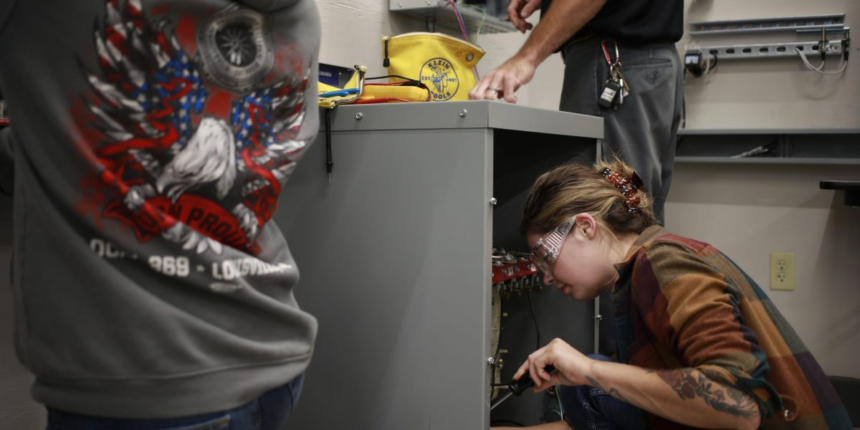
When Nicholas Bowman was in high school, he thought his next steps were already mapped: He’d get a college degree and land a stable, high-paying job—enjoying the kind of economic mobility higher education has long promised.
But as application deadlines loomed, doubt crept in. What was so great about spending four years in classrooms, taking on tens of thousands of dollars in debt, and still facing no guarantee of a solid living?
That’s when a family friend suggested a different route: an electrical apprenticeship. Bowman investigated—and it felt like a no-brainer.
He could start earning about $42,000 in his first year while taking classes just two nights a week at his local IBEW chapter in Newport News, Va. By the time he graduates as a journeyman this summer, he expects to make around $71,000—and, as he puts it, spend his days in a job that feels like he’s playing with “adult Legos.”
Bowman, now 22, is part of a growing wave of Gen Z workers reconsidering jobs once treated as not even worth their consideration: electrical work, HVAC, plumbing, and other skilled trades. Part of that shift is cultural—there’s less stigma, more TikTok visibility, and more open talk about student debt and wages. But part of it is economic: Many entry-level white-collar jobs are feeling more like pits than ladders. Companies have been rethinking their hiring practices as questions around the future of work spiral in the wake of the rapid adoption of artificial intelligence.
Projections suggest that more than 300,000 new electricians are needed over the next decade to meet AI-driven demand, particularly as a large share of today’s workforce is approaching retirement. Nearly 30% of union electricians are between the ages of 50 and 70; about 20,000 electricians are expected to retire each year, or roughly 200,000 over the next decade.
That means that to meet the lofty expectations around AI, the country needs hundreds of thousands of Nicholas Bowmans. And Big Tech and local electricians’ unions are pulling out all the stops to find and train them.
Data centers—warehouse-size facilities packed with servers, power gear, and cooling equipment that provide computing power—are nothing new. They have been spreading across the world since the early 1990s, powering everything from your iPhone’s camera to international financial markets.
Amid all the complexity, one constraint outweighs them all: There are not enough workers.
Associated Builders and Contractors, a trade organization, estimates the construction industry will need to attract an estimated 349,000 net new workers in 2026 alone to meet demand for its services. But for data centers, electrical work isn’t just one trade among many—it’s the spine of the project.
“The electrician shortage is quite dire,” Darrell West, a senior fellow at the Brookings Center for Technology Innovation, told Fortune. “Those people are in short supply all across the country, and this has become a leading barrier to data center construction.”
The irony is hard to miss: The same companies remaking white-collar career paths with AI are discovering that their own growth may hinge on the very generation feeling the most economic whiplash from it.
That mindset, industry leaders said, helped sideline the skilled trades.
“Despite the good intentions that may have given birth to that philosophy 50 years ago that everybody had to go to college or you’re completely doomed—they treated the trades as a consolation prize,” said Brian Huff, founder and CEO of for-profit training organization Midwest Technical Institute.
Now, the math is shifting.
Enrollment in electrical programs across Huff’s four campuses in Illinois and Missouri has surged more than 400% in the past four years, to nearly 400 students. The average attendee isn’t fresh out of high school, he said, but in their mid- to late twenties—someone who tried other paths first and is now looking for something more reliable.
“It’s never been brighter than this,” said Huff, who started his own career as a welder. “The job prospects for anybody getting into this are going to be good. They were good before, but they’re even better now.”
The surge isn’t limited to private programs. According to the National Electrical Contractors Association, applications for commercial apprenticeships increased by more than 70% nationwide between 2022 and 2024, from roughly 70,000 to 120,000—far more than the number of available positions.
Ian Andrews, vice president of labor relations and large contractors at NECA, said the scale of demand tied to data centers has sparked a blue-collar boom the electrical field has waited decades to see.
There isn’t a single path to becoming an electrician, but the most common route is an apprenticeship that typically lasts four to five years. Unlike college students, apprentices earn money from day one when completing classroom instruction, often taking classes at night or in short blocks throughout the year. By the time they finish, many have years of experience—and little to no student debt.
Bowman said that tradeoff wasn’t always obvious to his family and peers.
“Most people were open-minded when I explained it, but naturally, high school pushes college,” he said. “There’s not much exposure to careers that let you start working right out of high school. I think more people could benefit from that awareness.”
The financial upside can be significant—especially in regions experiencing a surge in data center construction.
Other students begin at community colleges or trade-focused institutions, taking classes full- or part-time before being hired by a contractor. Those programs can serve as on-ramps for students who want exposure before committing to a union apprenticeship or who are transitioning from another field.
“Data centers are going to be the new oilfield,” said Nathan Hall, vice chancellor of external affairs and public relations at Delta Community College in Monroe, La. The jobs, he added, are reshaping the local economy—bringing steady income to families and expanding apprenticeship pipelines in communities that have long been overlooked.
On paper, becoming an electrician right now can look, as Bowman found, like a no-brainer: Earn while you learn, avoid massive student debt, step into strong wages, and work at the center of the AI infrastructure boom.
But it won’t be for everyone. The work can be physically demanding, with long hours on your feet. Some days you might be indoors, in air-conditioned spaces, and other days, you might be down in a muddy ditch pulling cable.
The lifestyle can be just as arduous. Add tight construction timelines, and overtime can become a norm. Work often follows the project—not the other way around.
“At first, that elephant tastes good, but pretty soon you’re sick of it … It’s endless. Every time you open your mouth to breathe, there’s more elephant,” Dedon said.
As Dedon put it: “Sick as you are of eating it, even the biggest elephant ends. Then what are you going to eat?”
For many electricians, that’s always been the tradeoff; long commutes or even weeks away from home might be tough, but it can bring higher-paying salaries.
But one added cushion for the electrician shortage is that the demand is not limited to data centers. The same skills can be transferred to other locations, like power plants, hospitals, and military bases—all of which are often undergoing new waves of electrification.
For Bowman, the tradeoffs are clear—the dirt, the hours, the uncertainty between projects. But so is the payoff: steady pay, in-demand skills, and work that can’t be automated away. “The fortunate thing is AI hasn’t found a way to turn the wrench yet,” Bowman said. For now, that feels like a bet worth taking.
“We have historically referred to apprenticeship in this country as one of the best-kept secrets,” Andrews of NECA said. “And I would proclaim that it is no longer a secret. It is an open invitation to explore this career.”