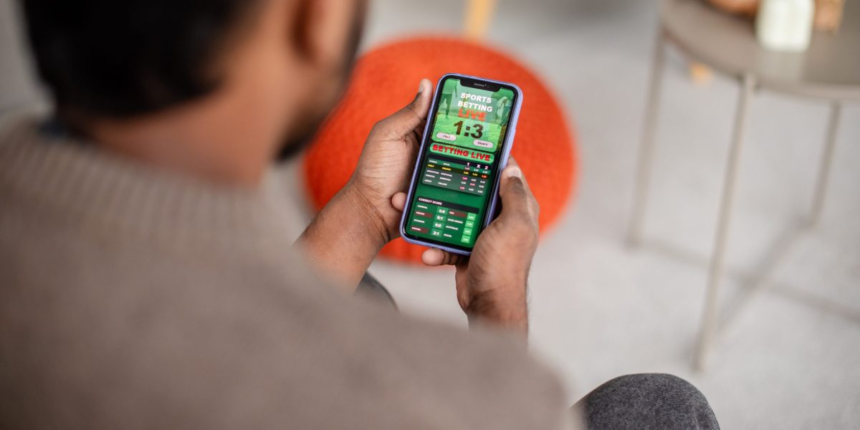
As Missouri launches sports betting Monday, people will be able to wager on how many points a particular athlete will score in a game — so long as it doesn’t involve a Missouri college or university.
All centered around the outcome of prop bets, a popular type of wager often focused on what individual players will do in a game — like achieving a certain number of strikeouts in baseball, racking up a certain amount of points and rebounds in basketball, or surpassing a particular passing yardage in football.
For bettors, a lot can ride on one player, putting those athletes at risk of threats or enticements to rig their performance.
Sports betting operators took in over $11 billion through the first three-quarters of this year, up more than 13% from the same span last year, according to the American Gaming Association, which represents the industry.
Though national data is lacking about the prevalence of prop bets, they are “an increasingly popular way in which to provide for engagement for any type of fan,” said Joe Maloney, the association’s senior vice president of strategic communications.
West Virginia, which was among the first to allow sports betting after the court ruling, now is collecting a trove of data from the industry. During a roughly one-month period this summer, prop bets comprised more than half of all wagers made through one of the largest sports betting platforms, said Brad Humphreys, an economics professor and director of the Center for Gaming Research and Development at West Virginia University.
Additionally, he said, almost all bets involved parlays, where two or more wagers are grouped together under the umbrella of a larger bet. To win, a person must be right on each prong in the bet, making the odds of success longer and the potential payout larger.
Because prop bets “speed up the ability to make multiple bets,” they carry a higher risk of developing addictive behavior for some bettors, said Rachel Volberg, a research professor of epidemiology at the University of Massachusetts Amherst who has spent decades studying gambling.
States have widely differing rules for bets on college athletes. More than a dozen states place no limits on collegiate prop bets while an equal number prohibit all such bets. Other states fall somewhere in between. Missouri is one of over a half-dozen states with a prop bet prohibition pertaining only to games involving college teams from their states.
“We thought this was a good middle ground that had worked in other states and that would uphold the integrity of the games here,” said Jack Cardetti, a spokesperson for the Sports Betting Alliance, an industry group that supported Missouri’s amendment.
A blanket ban on prop bets likely would drive people to illegal and unregulated sportsbooks, placing bettors at greater risk and making it harder to flag problems, the Sports Betting Alliance said.
Others doubt that Missouri’s narrowly tailored prop bet restrictions will have much impact in an Internet-connected society where people can easily bet on athletes playing anywhere in the U.S.
“That’s going to be a Band-Aid on a dam that’s breaking here,” said Nathan Novemsky, a professor of marketing and psychology at Yale University, “because folks will just make those bets on other teams.”
The Missouri Gaming Commission has three employees focused on regulating sports betting and is looking to hire a fourth, said commission chair Jan Zimmerman.
The criminal charges, player penalties and policy changes involving prop bets are “a demonstration that the market is really working as intended,” Maloney said.
The scandals aren’t deterring some Missouri residents who have been eagerly waiting for sports wagering.
Brett Koenig, who lives in suburban St. Louis, has occasionally crossed the Mississippi River into Illinois to legally bet on sports. Others who live in the Kansas City area have driven across the border into Kansas, pulling over at the first exit to place bets from smartphones. The drive allows bettors to get around geolocation technology that blocks bets from people in states where it’s not legal.
Koenig said he plans to bet on Monday night’s NFL game without leaving his home. He might place some type of prop bet, if he likes the odds.