“Watch out for allies and creditors losing confidence, the loss of its reserve currency status, the selling of its debt assets, and the weakening of its currency, especially relative to gold.”
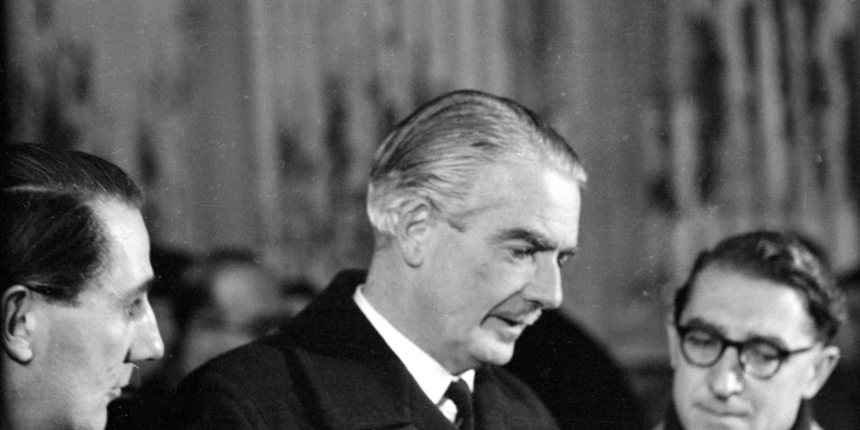
That afternoon, British Prime Minister Anthony Eden received a phone call that ended an empire.
In late October 1956, Britain and France — alongside Israel — invaded Egypt after President Gamal Abdel Nasser nationalized the Suez Canal, the vital trade artery connecting Europe to Asia. Militarily, the operation was a success. Within days, Anglo-French forces controlled the northern portion of the canal, but it unraveled off the battlefield.
The United States, alarmed by the unilateral action and unwilling to allow its allies to destabilize the Cold War equilibrium, applied crushing pressure. Washington threatened to withhold emergency IMF loans as the British pound came under speculative attack. It was financial warfare, and it worked. Eden, facing a currency crisis, withdrew from Egypt in humiliation within weeks.
The military had won. The empire had lost. And what followed was a cascade that Dalio, in Bridgewater’s research, describes as the classic sequence of imperial decline: allies stopped deferring to London; creditors reassessed British debt; the pound sterling — which had served as the world’s reserve currency for over a century — began its long retreat. Within four years of the Suez Crisis, Britain had granted independence to Ghana, Malaya, Nigeria, and Cyprus. Within a decade, Harold Macmillan’s “winds of change” speech had formalized what Suez had revealed: the British Empire was in managed retreat, not strategic expansion.
Today, Britain is a prosperous, mid-sized economy of nearly 70 million people, with a GDP that ranks fifth globally — behind the United States, China, Germany, and Japan. It is a respected member of NATO and the G7, a permanent member of the UN Security Council, and home to London, one of the world’s great financial centers. But its “special relationship” with the U.S. is not the same as it was before the Suez Crisis.
Dalio compared the Hormuz standoff directly to the Suez crisis in March — invoking a pattern he says has recurred across centuries: a rising power challenges the dominant empire over a critical trade route while the world watches, as money and alliances shift toward the winner.
The U.S. and Israel launched a bombing campaign against Iran beginning in late February, followed by a ceasefire and months of grinding, inconclusive negotiations. American forces struck nuclear sites, missile facilities, and military installations across the country. The Iranian regime was battered, its economy buckled, and yet Iran survived. Regime change never happened, and the nuclear program was not verifiably dismantled.
By late June, U.S. negotiators were still in Qatar, pursuing a memorandum of understanding to reopen the Strait of Hormuz in exchange for phased economic relief — a far cry from the decisive victory the operation’s architects envisioned.
Two key factors behind the decline are the “petrodollar” system and the national debt. To get the former, you have to flash forward to a 1974 handshake that the public wouldn’t learn about for another 42 years.
French Finance Minister Valéry Giscard d’Estaing called it an “exorbitant privilege.” Economist Yanis Varoufakis called it “the global minotaur” — likening the U.S. to the ancient king of Crete who held international trade captive to tribute.
The Strait of Hormuz is where that privilege has always been physically most exposed.
The Suez analogy has limits that its most serious proponents acknowledge. Dalio frames this as a contingent possibility, not a certainty. The United States remains the world’s largest economy, its military without peer in raw capability, its cultural reach still unmatched. Crisis conditions historically drive a flight to dollars, not away from them.
Britain’s pound had been the anchor of global trade since the Napoleonic era; it took two world wars, a Great Depression, and a humiliation in Egypt to finish it off. The dollar’s own arc runs roughly 80 years, from the 1944 Bretton Woods agreement, where the victorious United States anchored the postwar monetary order to a simple promise: every dollar was redeemable for gold at $35 an ounce. It mutated again in 1971, when the costs of Vietnam and the Great Society had so strained American finances that Nixon unilaterally slammed the gold window shut — ending dollar convertibility overnight and untethering the currency from any hard constraint. What replaced the gold anchor was something more abstract and more fragile: the credibility of American power itself, significantly boosted by the forthcoming secret Petrodollar deal.
What is different now — what makes the Iran war more than just another Middle East misadventure — is the convergence: a $39 trillion debt load, a 30-year low in the dollar’s share of foreign reserves, a physically threatened petrodollar chokepoint, and a domestic political climate that has made endurance nearly impossible.
But Dalio’s warning cuts through the reassurances: “Both sides know that the final battle, which will make clear which side won and which side lost, still lies ahead.”
For this story, Fortune journalists used generative AI as a research tool. An editor verified the accuracy of the information before publishing.