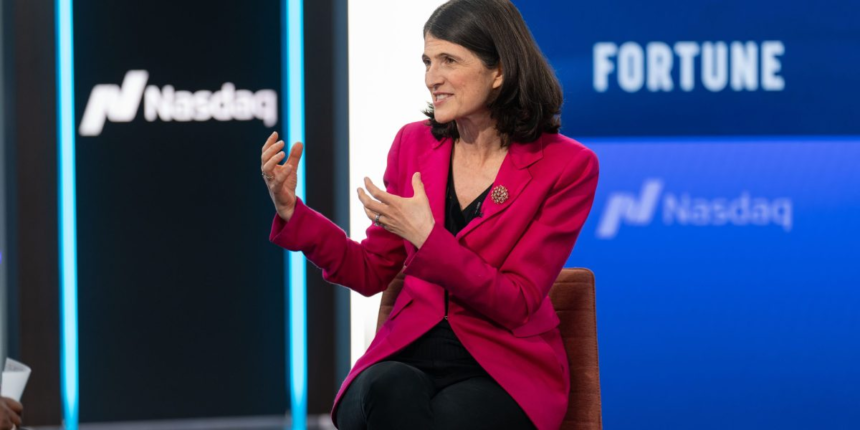
Sarah Youngwood has a ranking system for artificial intelligence—and it has nothing to do with algorithms. Inside Nasdaq’s finance function, employees now earn belts for AI proficiency the way martial artists do: white belts for foundational knowledge, advancing through levels that require hands-on delivery and the ability to teach others. Youngwood has mandated that everyone on the finance team reach at least white belt. Her long-term goal is for 20% of the team to reach black belt status.
The belt system is one window into how Youngwood, EVP and CFO of Nasdaq, is approaching what she calls an embedded capability—not a standalone initiative. AI, in her view, should be reshaping everything: market infrastructure, internal finance operations, workforce culture.
“If we are Nasdaq, it is our role to lead the charge,” she told Fortune earlier this month from her 26th-floor corner office above Times Square. “To show what AI can do and how we can become an AI-first finance function.”
AI will be incredibly powerful for forecasting in finance, Youngwood said. By combining macro assumptions, pipeline data, and leadership actions, it enables better real-time decision-making—the core goal of any finance function, she explained. Its impact spans everything from cash allocation to invoice processing and beyond. Governance and human oversight are essential to the process, she said.
“We are the trusted fabric of the financial system,” Youngwood said. Where we apply AI is in everything we do.”
Despite the rapid pace of AI adoption, Youngwood applies a familiar financial lens to technology investment: return on invested capital.
The measurement framework works in three stages. First, Nasdaq looks at employee engagement: are people completing AI training and actually using the tools? Next comes velocity: is AI improving throughput, accelerating workflows, or enabling faster development cycles? Only then does the company measure financial impact—what those gains translate to in revenue growth, cost efficiency, or productivity.
That discipline extends to how Nasdaq allocates capital across time horizons. The company categorizes investments into “horizon zero”—foundational needs like cybersecurity—followed by short-term return initiatives, medium-term bets, and longer-term R&D. Youngwood uses the same framework to evaluate AI spending, treating it not as a separate budget category but as a lens applied across the whole portfolio.
That foundation required years of groundwork. Over the past two years, Nasdaq has focused on standardizing data definitions, centralizing information, and building dashboards capable of supporting more advanced AI applications. “You need your data in tip-top shape,” Youngwood said. “Once you have that, you’re prepared for generative AI.”
Investments Nasdaq made a decade ago in cloud infrastructure and early AI capabilities now underpin its positioning in generative AI. “We couldn’t see the whole map at the time,” Youngwood noted. “But those small investments gave us the foundation to be very well positioned today.”
Youngwood uses AI across her function for everything from administrative tasks to forecasting and financial planning, with more advanced initiatives integrating AI into core systems and workflows. She has also made sure her top technology leaders sit at the same table as the finance team—a deliberate signal of how tightly finance and tech are now linked.
The same logic applies externally. “What we’re doing with AI is putting it everywhere—in every process for our clients and for ourselves,” Youngwood said. One example: Nasdaq Verafin’s Agentic AI Workforce platform, launched last year, is now used by 650 financial institutions. Youngwood points to ease of implementation as a key factor in its adoption.
As for her own “belt” journey, Youngwood gets no special treatment. She is going through the new process alongside her team and is on track to reach yellow belt next month, with plans to soon progress to green.