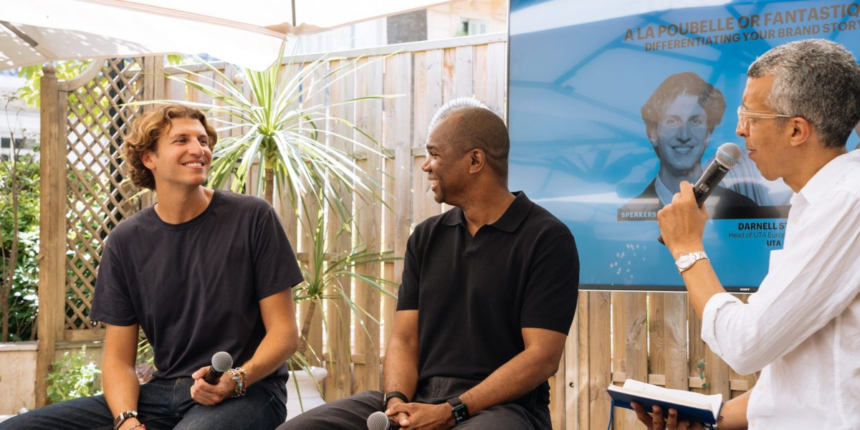
Fortune opened its flagship Fuel Up event at Cannes Lions International Festival of Creativity with a panel discussion with Gstaad Guy, the fictional Swiss bon vivant whose alter ego skewers the ultra-wealthy and lampoons the luxury brands many in the room work for.
His signature verdict on anything falling short of his exacting standards: À la poubelle. Straight to the bin, darling. A mediocre canapé? À la poubelle. An uninspired brand campaign? À la poubelle. The word authenticity, deployed lazily at a marketing conference? Absolument à la poubelle.
Gstaad Guy has become a sought-after partner for the very brands he satirizes, most recently through a collaboration with Bentley. “People are buying the things I’m speaking about playfully, without me trying to sell them,” he said. “I was talking about the brands I work with today long before working with them. That’s where the authenticity comes in.”
“I was talking about the brands I work with today long before working with them. That’s where the authenticity comes in”
“When a connection is authentic and real, it’s obvious to both parties,” Gstaad Guy said. “And when it’s artificial or forced, it’s equally obvious. The audience always knows.”
That tension is particularly visible in sport, where audiences are among the most invested and the least forgiving. Brands spend enormous sums trying to capture attention, yet sport is one of the few places where it is genuinely given rather than grudgingly captured.
“Sport is the great unifier,” said Emily Ketchen, senior vice president and CMO of Lenovo’s Intelligent Devices Group. “Whether you support the same team or not, you can talk about it and have fun.”
For Toby Craig, chief communications officer at Manchester United Football Club, the fans need to be treated as invested participants, rather than passive consumers.
“They give us their time, they give us their passion, and they give us their commitment. And they expect the same back from us,” he said. “We want to have relationships where the brands who work with us activate in an authentic way.”
Craig cited the club’s deal with Qualcomm’s computer chip and processor brand Snapdragon. It works, he said, because its devices are genuinely used to shoot Manchester United’s football content. The test, Craig said, is whether the partnership produces something real for fans rather than just decorating the shirt.
Now in its second year, the race takes place on the same weekend as the Indianapolis 500—one of the biggest race days in U.S. sport—and ends with the winner being doused in mustard and handed the Borg-Wiener Trophy. Last year’s inaugural event drew 85,000 attendees and millions of livestreamers.
“Someone had the idea of racing them at Indianapolis to mark the start of America’s grilling season,” Kaplan said. The Wienermobile has been part of American culture for 90 years, long before anyone thought to race one—and that history, Kaplan argued, is what makes the event feel authentic.
“Live sports is the last great lean-in moment,” he said. “If you can find a way to organically, authentically connect, that is what we’ve been focusing on.” The best ideas, he added, come from unbriefed sessions where agency partners fire ideas at one another. “A lot of our best ideas are unbriefed ideas.”
AI is also changing the way marketers approach creativity and portray authenticity. More than three-quarters (78%) or marketers say they are concerned that increased AI use could reduce consumer trust in brands, according to a survey of 1,100 marketing and finance decision-makers across the U.S., U.K., and Canada, conducted by Fortune in partnership with Morning Consult.
One-third (34%) believe AI will replace some creative functions and 19% think it will significantly reduce the need for human creativity altogether.
Despite AI’s perceived threat to the creative function, Lucinda Barlow, head of international Marketing at Uber, believes the technology cannot replicate the human emotion, such as humor or entertainment, that is a requirement for the best campaigns. “Those feelings are really hard to replicate with AI,” she said.
“What I’m feeling this time is a deep acknowledgment of the power of human creativity…that this is actually seen as a competitive advantage for your brand, for your business”
Timothy Young, CEO of marketing AI agent business Jasper AI, believes the greatest benefits of AI depend on the people using it. “You need somebody on your marketing team that really understands the human side to be a tastemaker and shift what the model is doing,” he said. “That’s where you can find the magic accelerator for your brand.”
He added: “Authenticity is a function of trust over time.” The brands that chase every meme are the equivalent of the artist who sold out on their sophomore album. “We all know those artists. Their whole catalog tells the story.”
Last year at the Cannes Lions festival, Barlow recalled that most panels celebrated AI, while the conversations offstage feared it. “People would get off the panel and immediately say, ‘Oh my god, I don’t think I’ll be here next year. I’m going to lose my job.’”
However, this year, she said, the attitude towards AI was different. “What I’m feeling this time is a deep acknowledgment of the power of human creativity…that this is actually seen as a competitive advantage for your brand, for your business.”
Regardless of what the technology can do, people’s judgment, so far, remains unchanged. Audiences cannot be fooled and the brands still trying to manufacture what can only be earned…well, à la poubelle.