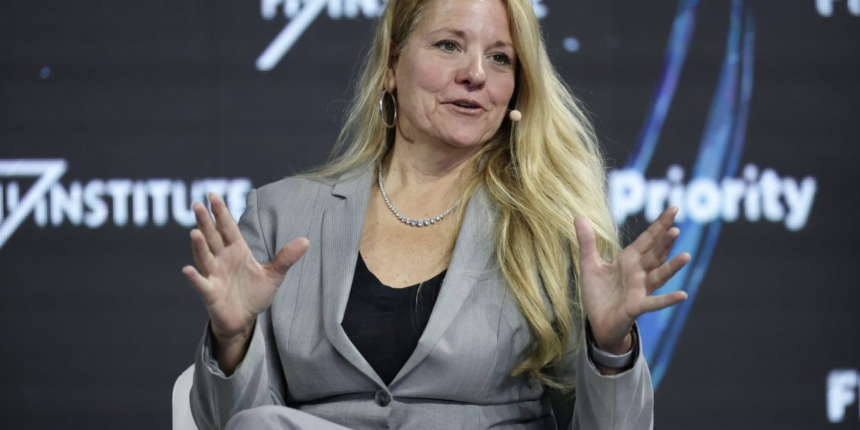
Eighteen years later, that woman with paper in her shoes became a billionaire, owning 12.6 million shares of the most valuable company ever to go public. Based on Friday’s closing price, that means her stake is worth more than $2 billion.
The cheerleader who fell in love with an engineer’s shoes
Shoes, as it happens, helped guide Shotwell to where she is now. Shotwell was born in 1963, the middle of three daughters of a brain surgeon and an artist, and raised in Libertyville, Illinois. She watched the Apollo 11 landing at age five and found it boring. At Libertyville High she was a cheerleader and varsity basketball player who finished at the top of her class. But she had no idea what she wanted to do until her mother dragged her—destination undisclosed, because she wouldn’t have gone—to a Society of Women Engineers panel at the Illinois Institute of Technology.
Then in 2002, she had lunch with a former colleague who’d jumped to a startup called SpaceX. The colleague gave her a tour afterward, and Shotwell talked to Elon Musk for three or four minutes. “I wasn’t looking for a job. I didn’t have a résumé,” she said. But that afternoon, SpaceX called and asked her to apply to run business development.
After a month of hesitation that ended while pulled over on an LA freeway, she became employee No. 11, leaving a stable job where she held a 3% stake.
“I called him on the phone and I said, ‘[I’m] an idiot,’” she recalled at Stanford. Musk laughed and said, “Welcome to the team.”
She had made up her mind at that point that if SpaceX failed, she was done with the industry entirely: “I’d rather sell real estate or be a barista.”
She is still not the “central casting” engineer. She likes wearing black skinny jeans, platform heels and Chardonnay. She reads Outlander novels to fall asleep and has been prepping her 1,000-acre Texas ranch to one day become a vineyard. “I drink a lot of wine,” she joked to Marie Claire. “Actually, reading is probably the thing that calms me the most.”
“I need more data than Elon”
Her job is one that requires inordinate calm. Functionally, the task is converting Musk’s pie-in-the-sky ambitions into practical deadlines. “I need more data than Elon does to make a decision,” she said at Stanford.
The company has a tendency to hit its targets but not its deadlines, a trait she defends without apology: “We fail on timeline, but that feels like the right fail to make.” Musk’s own version, which she repeated to investors on CNBC ahead of the IPO, goes something like, “We make the impossible, we just make it late.”
Now, that doctrine is up to investors to decide. SpaceX’s prospectus promises the world and beyond; AI data centers in orbit by 2028, a Starship that turns around “like an airplane,” and a million-person Mars colony.
When CNBC’s Morgan Brennan asked when to expect that colony, Shotwell guessed 2035, then immediately qualified that she’s “so bad at predicting timelines.”
She asked retail investors to cut the company some slack, adding that she doesn’t want to focus on earnings because “What we’re doing is very futuristic.”
That might work in the short run. But as OpenAI and Anthropic also make their public debuts and swallow oxygen from the capital markets, investors will weigh SpaceX’s version of the future versus the other companies’ lofty goals. Since SpaceX absorbed xAI, it has taken on $29 billion in debt, making it a deeply unprofitable company. The company went “from those penurious Falcon 9 Dragon days to the more expensive capital-intensive Starship, and then to AI, because it is next-level expensive,” Shotwell said.
But the company is used to burning cash. After all, that was the story of its first decades; failed launch after failed launch, enough that Shotwell understands failures as an asset. “If a launch goes perfectly, all you’ve learned is that that launch vehicle on that day worked,” she told investors. “When you have failure, you actually get this treasure trove of data.”
Shotwell embodies the hedge against “key-man risk.” During Musk’s June 2025 feud with President Donald Trump—when Musk threatened to decommission the Dragon capsule—she quietly assured NASA the tensions would boil over.
She has defended him on even more personal levels. Against her press team’s advice, she sent a companywide letter after harassment allegations surfaced in 2022: “I don’t believe he could have done what he was accused of. But he is imperfect. I’m imperfect.”
She argued Musk is “probably the best CEO in history, in my opinion, humble opinion,” and that the supermajority-voting control he holds is correct. Pressed on succession, she allowed only that “the company would not collapse obviously without Elon, but it would by no means be the same.”
But her own ambitions are more modest than Mars. Given a Starship and anywhere to go, she’d pick the moon. After all, Mars takes six months to get to, and “I don’t like to camp.”