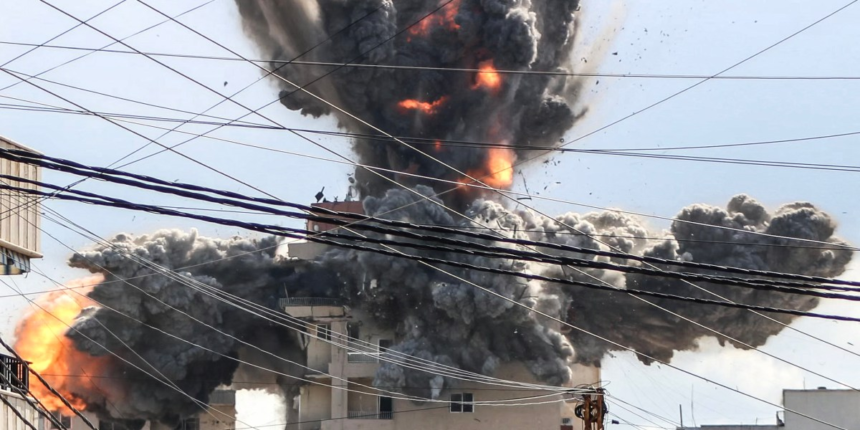
As Wall Street races to incorporate war into its risk scenarios, the same people modeling natural catastrophes are now adapting their methodology to help investors, banks and insurers predict military conflicts.
“Instead of looking back, insurers and investors increasingly want to know what might happen and where,” Sam Haynes, head of data and analytics at Verisk Maplecroft, a global risk consultancy, said in an interview. “They want a predictive forward-looking view.”
Verisk, which is best known for its work on natural catastrophe models for insurers and cat-bonds investors, has just unveiled a model it says would have helped financial professionals predict the Iran war.
The firm’s Predictive War Index, released to clients in late May, uses a machine learning algorithm to forecast the likelihood of war occurring in a country over the next 12 months. It was trained on political, economic, and social datasets from 1995-2022 and therefore doesn’t take the current Iran war into account. Even so, back-testing showed that had the model been ready in early January, it would have shown a 66% probability of war breaking out in Iran 1 1/2 months later, according to Verisk.
The firm’s other new model, the Geopolitical Relations Index, tracks the changing level of tension between pairs of countries. It looks at parameters such as whether they’ve had military clashes in the past, how similar their styles of government are, or whether they’re geographically close enough to project power.
A separate Verisk model, launched in October 2023, has in the period since then correctly predicted six out of seven government collapses, including the ouster of Bashar al-Assad in Syria in 2024, and the sudden removal of Venezuela’s Nicolas Maduro in January.
In the case of Maduro’s removal, “there were economic issues combined with a past history of political instability that increased the risk,” said Chris Boylan, a data science expert at Verisk Maplecroft.
Rand Corporation has an artificial-intelligence model that turns complex and uncertain questions — such as regime change — into concrete probability estimates. The model draws in part on the aggregated opinions of people who aren’t subject-matter experts to forecast a future scenario. When the model was run in mid-May, it showed a 20% likelihood that Iran’s regime won’t survive into 2027.
Traditional models often stop working in the current climate because an event like a trade blockade or the imposition of economic sanctions “doesn’t behave like a standard-deviation move in a normal distribution,” said Krishan Sharma, senior vice president – model risk management at Citi. “It changes the distribution entirely.”
The shipping disruption in the Strait of Hormuz has brought fresh attention to the extreme vulnerability of similar transport chokepoints around the world, requiring new risk algorithms for marine insurance and global trade. Shortly after the Iran war started on Feb. 28, Lloyds of London was quoting premiums for marine war risk in the Strait of Hormuz as high as 1% of a vessel’s value per voyage, compared with just a fraction of a percent before the conflict, according to Moody’s.
Modeling experts are now looking at conflict scenarios as they would a terrorist attack, “where relatively low‑cost acts can generate disproportionate economic losses,” said Gordon Woo, a catastrophe risk specialist at Moody’s. With the new models, insurers can better assess how disruptions might unfold across shipping routes and supply chains rather than focusing solely on physical damage to individual assets, Woo said.
The events unfolding “are consistent with our supercycle geopolitics thesis, where increased risk drivers are breaking through global guardrails and causing a higher number of geopolitical shocks,” she said on her website. “2025 saw the acceleration of the supercycle and it marked a wake-up call for the C-suite.”
The newer risk models will allow insurers “to integrate a predictive view of war into their underwriting and exposure management workflows,” Verisk said.
“War is a rising fear for businesses around the world,” it said.