Hello and welcome to Eye on AI. Beatrice Nolan here, filling in for AI editor Jeremy Kahn, who is in Aspen at Fortune Brainstorm Tech. In this edition…The plan to give Americans a stake in AI…OpenAI files a confidential S-1 with the SEC…Anthropic rings the alarm on “recursive self-improvement’”..and AI consciousness goes mainstream.
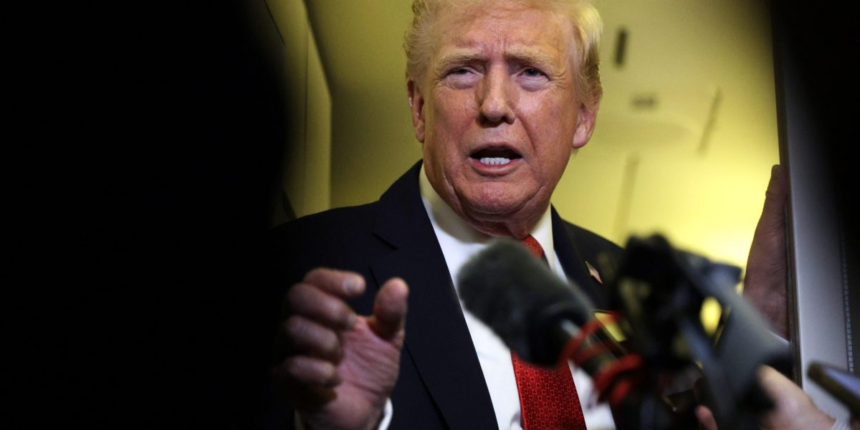
Last Friday, President Donald Trump surprised reporters aboard Air Force One by suggesting that the U.S. government may take direct equity stakes in leading AI companies. “There are concepts where pieces could be given to the American public, where the American public essentially becomes a partner,” he told them. “You make them a partnership in this revolution.”
Trump and Altman aren’t the only ones floating the idea of government involvement in the AI industry. In an unusual ideological convergence, Senator Bernie Sanders (I-VT) proposed a one-off 50% tax raid on AI labs while Steve Bannon, Trump’s former chief strategist, went further, arguing the government should force AI companies to hand over 50% of their equity.
Hamza Chaudhry, AI and national security lead at the Future of Life Institute, a nonprofit focused on reducing existential risks from AI, told Fortune that what is striking about this moment is that leading progressive Democrats and the Trump administration are, from completely different starting points, converging on the same basic intuition. That is, that AI’s trajectory is “inseparable from the public interest, and that the wealth it generates cannot simply accrue to a handful of private actors.”
While there is some crossover, the two proposals on the table are very different things.
The Trump/OpenAI framework is voluntary—AI companies would donate a small equity stake to the federal government rather than sell it. While its unclear what the equity stake would actually be, some industry sources are estimating somewhere between 1% and 5%.
The donated shares would seed what OpenAI has branded a “Public Wealth Fund,” outlined in the company’s April 2026 policy proposal, which says the fund “could be distributed directly to citizens, allowing more people to participate directly in the upside of AI-driven growth, regardless of their starting wealth or access to capital.” The structure is designed to avoid any taxpayer outlay or appropriations process, Chaudhry said, but the administration would likely need congressional authorization to hold equity in private companies under current law, or would need to route it through an existing or newly created government-affiliated entity.
In contrast, Sanders’ American AI Sovereign Wealth Fund Act is compulsory, mandating a 50% equity transfer, with the government gaining voting shares, board representation, and revenues directed toward cash payments and public goods.
Both proposals face serious implementation problems. Chaudhry noted that neither has resolved basic governance questions—who sits on the fund’s board, whether it holds shares passively or with voting rights, how an “AI dividend” would actually reach American households.
The Alaska Permanent Fund, which distributes oil revenues annually to state residents and is the closest domestic model, operates at the state level with a straightforward asset base. A nationally administered fund holding equity in loss-making, pre-IPO technology companies is a very different proposition. For OpenAI specifically, a donated equity stake has no agreed market price until the IPO, meaning the fund’s actual value at the moment of contribution is genuinely uncertain.
Despite this, there does appear to be some cross-party support for some form of public ownership. Chaudhry attributes this to a cross-ideological acknowledgment that AI is not an ordinary industry.
“It will reshape labor markets at a scale and speed that existing social contracts weren’t designed for, and the question of who captures that value is, fundamentally, a question of democratic governance,” he said. “Proposals in on the stake vary, and whether an equity stake is the right instrument is a matter of debate but the instinct driving it, that the public deserves both a voice and a material stake in the AI transition, is correct.”
With that, here’s more AI news.